Use the Loan Calculator to compare car, home and personal loan scenarios. Enter the offered rate, amount and term, then review the EMI alongside total interest, fees and the repayment schedule.
Car, Home & Personal Loan Calculator
Compare EMI, total interest and total repayment for car, home and personal loans in one calculator.
How this loan calculator works
The calculator uses the standard reducing-balance EMI formula. Select the loan type, enter the amount, annual interest rate and tenure, then calculate the estimated monthly EMI, total interest and total repayment.
Important
Results are illustrative. Actual EMIs may differ because of processing fees, insurance, pre-EMI periods, floating-rate changes, lender rounding and other loan terms.
Loan Calculator: 5 essential comparison checks
- Start with the amount actually borrowed. Keep the loan principal separate from the asset price and any deposit you pay yourself. Comparing offers for different principal amounts can make an EMI difference look like a rate advantage.
- Use a consistent tenure. A longer repayment period can reduce the monthly instalment while increasing total interest. Review both outputs before deciding that a lower EMI means a cheaper loan.
- Check the quoted rate basis. The tool uses a reducing-balance illustration under its displayed assumptions. Confirm the lender’s rate, repayment frequency, fixed or floating terms and any reset provisions.
- Review charges separately. The optional processing-fee input is not a complete annual percentage rate calculation. Additional charges, taxes, insurance or other product terms may affect the amount paid.
- Treat prepayment as a scenario. The optional one-time prepayment is modelled after twelve months. Confirm the timing, lender treatment and any applicable conditions rather than assuming every offer permits the same outcome.
Read the Loan Calculator outputs together
EMI is the estimated regular monthly payment. Total repayment combines the principal repaid and interest under the model. The fee output is shown separately so you can see how the stated processing charge affects the overall illustration. Avoid adding principal twice when comparing these totals.
The amortisation view shows how payments are allocated between interest and principal over time. Under a reducing-balance model, interest is calculated on the outstanding balance. A change in the rate, payment or prepayment timing can therefore change the later schedule.
A simple zero-interest illustration
If ₹1,20,000 is repaid over twelve equal monthly payments with zero interest and no fees, the payment is ₹10,000 per month. This checks the relationship between principal and payment count. An interest-bearing loan needs the EMI calculation and the actual contractual terms; this example is not a loan offer.
Compare the estimate with the lender’s documents
Keep the rate, principal, tenure and fee assumptions alongside the result. Ask the lender to explain a material difference from its repayment schedule before relying on your comparison. Review the RBI guidance on Key Facts Statements for context on APR and amortisation disclosures for covered loans.
The Loan Calculator is a planning aid, not an approval decision or affordability assessment. Compare the monthly payment with your wider budget and keep uncertain charges visible rather than assuming they are zero.
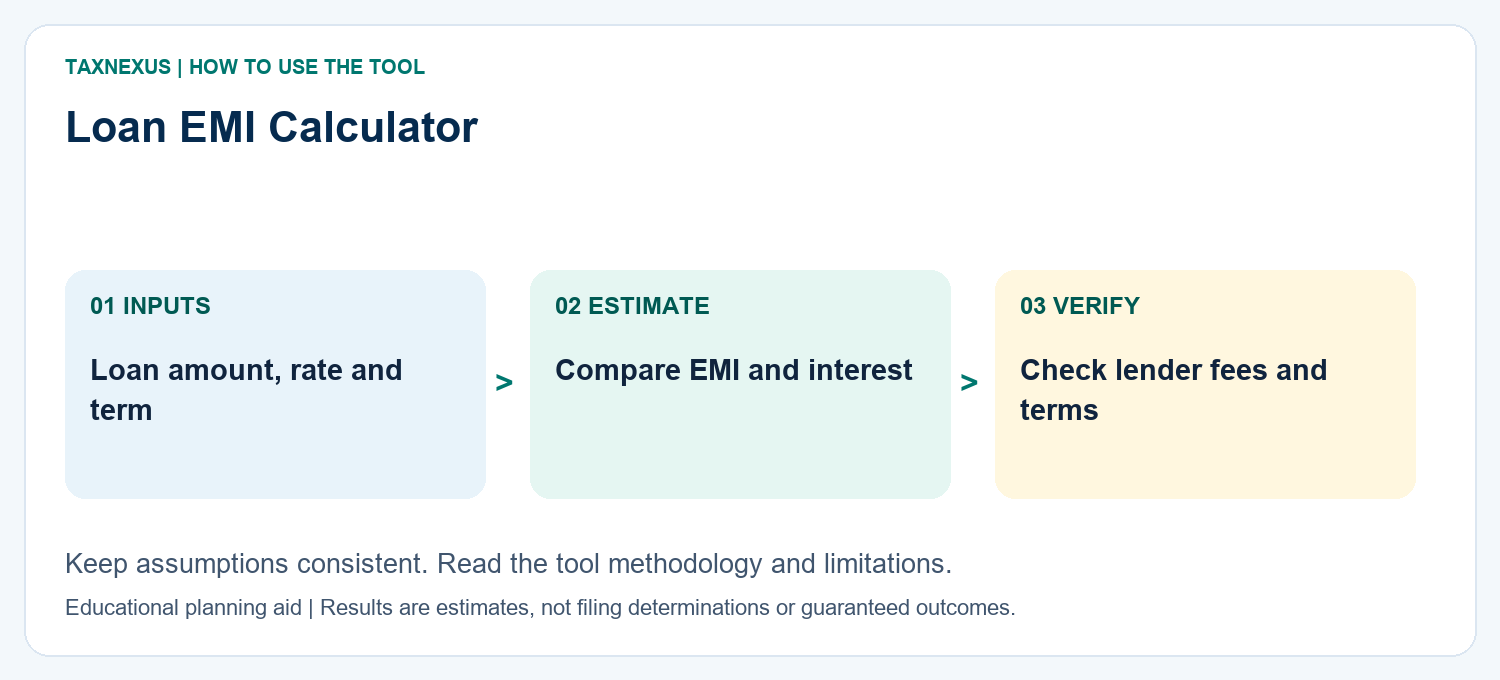
How to read your loan result
Use EMI to judge monthly affordability, but compare total interest and total repayment before choosing a tenure. Processing fees increase the effective borrowing cost. If you enter a prepayment, compare the estimated interest saved and revised tenure as well.
Planning note: A lower EMI can still mean a higher total cost when the tenure is longer.
Need a custom finance worksheet, calculator idea or help understanding a result? Contact TaxNexus and tell us what you are trying to calculate.
Ask TaxNexus
Send your question and the TaxNexus team can review what you are trying to calculate. The calculator page is included automatically.
Safety: Do not send passwords, OTPs, card numbers, bank login details or other confidential credentials.