GST in India: registration, invoices, returns, ITC and reconciliation
A practical compliance guide for businesses, finance teams and accountants—from GST registration and invoicing to GSTR-1, GSTR-3B, GSTR-2B, input tax credit and late-fee control.
Start here: GSTR-1 filing guide, GSTR-3B filing guide, GSTR-2B reconciliation guide, GSTR-1 vs GSTR-3B reconciliation, GST invoice and e-way bill checklist, and ITC reversal guide.
Editorial standards: About TaxNexus · Editorial Policy · Disclaimer

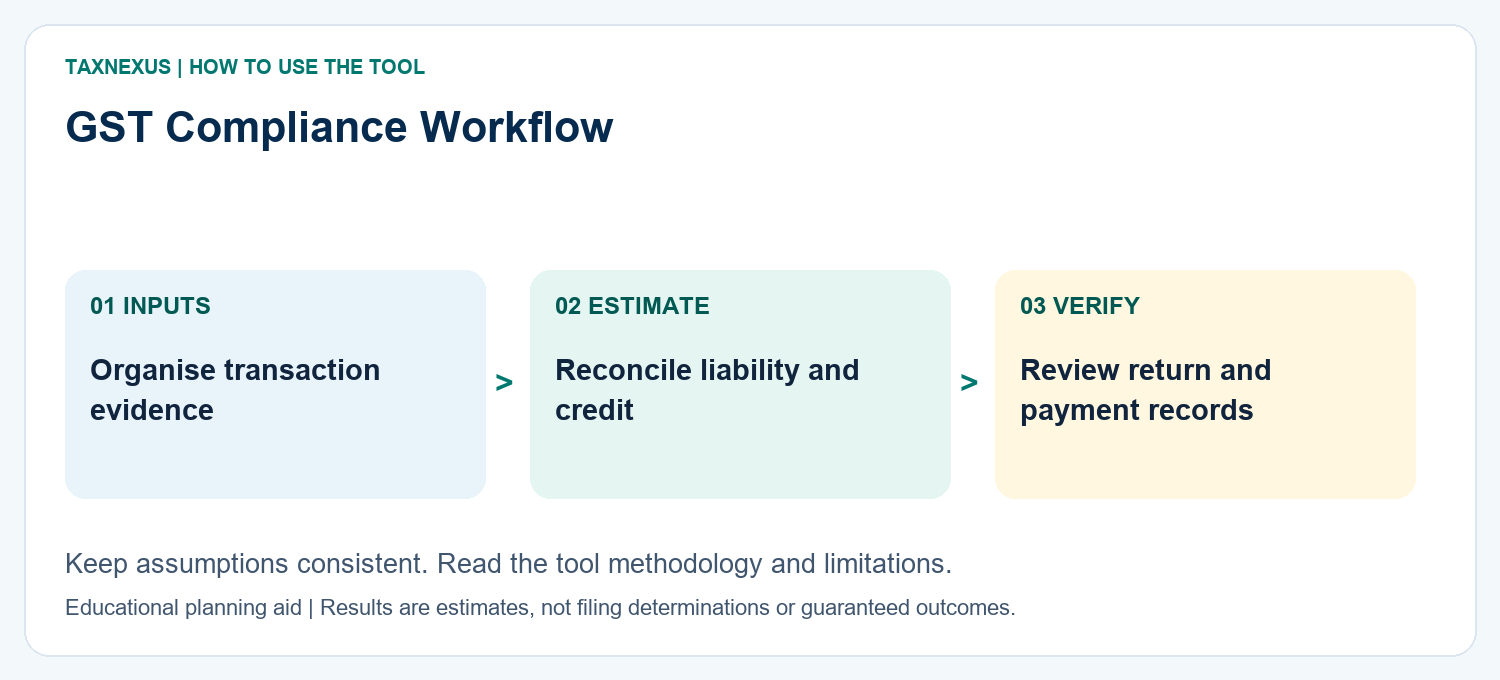
GST compliance is not just return filing. A reliable process starts with correct registration and invoicing, continues through outward-supply reporting and input-tax-credit reconciliation, and ends with payment, return filing and books-to-return reconciliation. Weakness at any one stage can create mismatches, blocked credits, interest or late fees later.
GST Late Fee & Interest Calculator
GST, TDS, TCS, PF, EPS & ESI Journal Entries
TDS Late Fee & Interest Calculator
TaxNexus Finance Calculators
1. GST registration: begin with the correct registration position
Registration requirements depend on turnover, the nature and place of supply, the type of taxpayer and specific compulsory-registration provisions. Because thresholds and exceptions are not identical for every case, businesses should check the latest official GST rules before deciding whether registration is mandatory.
Once registered, the GSTIN becomes central to invoicing, return filing, tax payments, e-invoice/e-way bill processes where applicable, and input tax credit matching.
2. Tax invoice essentials
Good GST compliance starts with accurate invoice master data. Finance teams should validate GSTIN, place of supply, invoice date/number, taxable value, HSN/SAC, tax rate, CGST/SGST or IGST treatment, reverse-charge applicability and any e-invoice reference where required.
3. GSTR-1: outward supplies
Official GST guidance describes GSTR-1 as the statement of outward supplies for normal and casual registered taxpayers, subject to the specified exclusions. It contains invoice-level and summary details of outward supplies, credit/debit notes, exports and other prescribed information.
The official GST Portal FAQ states that GSTR-1 is generally due on the 11th of the succeeding month for monthly filers and the 13th after the end of the quarter for quarterly filers, unless extended by notification. Nil filing can still be required where there is no business activity.
The Portal also states that corrections to previous-financial-year invoices in GSTR-1 are subject to the statutory cut-off; its current guidance identifies 30 November of the following financial year as the cut-off for amendments or missed invoices for that previous financial year, subject to law and later changes.
4. GSTR-1A: same-period correction before GSTR-3B
GST Portal guidance describes GSTR-1A as an optional facility that can be used to add or amend records for the same tax period after GSTR-1 and before filing GSTR-3B. Changes made through GSTR-1A flow into GSTR-3B, while recipient ITC consequences follow the portal’s stated timing rules.
5. GSTR-3B: summary return and tax payment
GSTR-3B is the summary return through which taxpayers report key liability and ITC figures and discharge tax. Even a Nil GSTR-3B has conditions: the GST Portal notes that a Nil return is appropriate only when there are no relevant outward/inward supplies, auto-populated data, manual entries or outstanding interest/late-fee liability for the period.
Before filing, reconcile GSTR-3B liability to GSTR-1 and the books. A mismatch between outward tax reported in GSTR-1 and tax paid in GSTR-3B should be investigated promptly.
6. GSTR-2B and input tax credit (ITC)
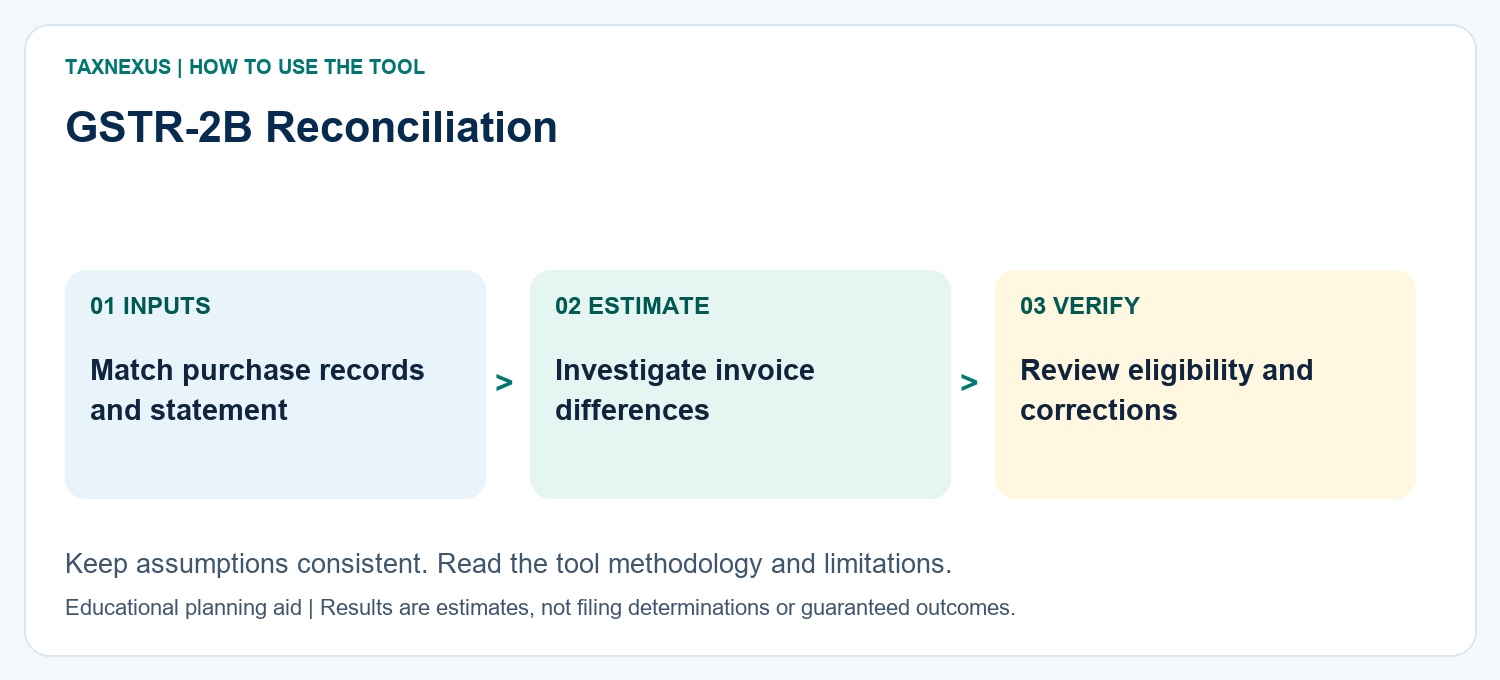
Input tax credit should be supported by valid documentation and the applicable statutory conditions. Operationally, many finance teams use GSTR-2B as a key reconciliation point against the purchase register. A good reconciliation identifies:
- Invoices in books but not reflected in GSTR-2B.
- Invoices in GSTR-2B but not recorded in books.
- GSTIN, invoice number/date or taxable-value mismatches.
- Credit notes and amendments.
- Blocked or ineligible ITC requiring separate treatment.
- Timing differences that should be followed up rather than immediately written off.
7. Monthly GST close: practical checklist
- Close sales and purchase invoice posting for the tax period.
- Validate GSTIN, HSN/SAC, place of supply and tax treatment.
- Reconcile sales register to GSTR-1 working.
- Reconcile purchase register to GSTR-2B and classify mismatches.
- Review reverse-charge transactions and other special liabilities.
- Reconcile output tax and ITC ledgers to the general ledger.
- Prepare GSTR-3B from reconciled figures—not from an isolated spreadsheet.
- Review late fee and interest exposure before filing.
- File using authorised credentials/DSC/EVC as applicable.
- Archive ARN, filed returns, reconciliations and supporting schedules.
8. GST accounting and journal entries
GST postings should reconcile to both returns and the ledger. Separate ledgers for input/output CGST, SGST and IGST, along with RCM and payable/receivable controls, make month-end reconciliation easier. See Important Statutory Journal Entries: GST, TDS, TCS, PF, EPS & ESI for examples.
9. Late fee and interest
Late fee and interest depend on the return type, delay, tax liability, nil-return status, turnover-linked caps and applicable notifications. Do not use a single generic late-fee figure for every return. Use the TaxNexus GST Late Fee & Interest Calculator as an estimate and verify the final amount on the official GST Portal.
10. Common GST control failures
- Incorrect GSTIN or place of supply on invoices.
- Reporting invoices in books but missing them in GSTR-1.
- Claiming ITC without reconciling supplier reporting and eligibility.
- Ignoring credit notes, amendments or reverse-charge entries.
- Filing GSTR-3B without reconciling GSTR-1 and the general ledger.
- Waiting until year-end to resolve vendor mismatches.
- Using outdated return due dates or late-fee assumptions after a notification change.
11. Official GST references
Use the GST Portal for filing and taxpayer services and the official GSTR-1 taxpayer guide for return instructions. For transaction-specific interpretation, also review applicable CGST/IGST provisions, rules, notifications and circulars.
GST & Business Compliance Learning Path
Follow this sequence for a practical monthly compliance workflow.