SIP Calculator: Monthly, Step-Up & Lumpsum
Compare monthly contributions, annual step-ups and one-time investments. Explore projected growth with your own return and inflation assumptions.
SIP deposits are modelled at the beginning of each month. Annual return is divided by 12 for monthly compounding; a step-up applies after every 12 deposits. Inflation is an editable assumption, not a forecast.
Year-by-year wealth breakdown
Cumulative contributions and projected investment growth.
Year-by-year accumulation schedule
| Year | Monthly SIP / one-time input | Cumulative invested | Estimated gains | Year-end value | Inflation-adjusted |
|---|
Educational projection. Returns are assumed constant; actual mutual-fund returns vary and capital can fall. These values exclude tax, exit loads and other charges. SIP instalments have separate holding periods, so a single LTCG rate cannot determine your redemption tax. No projection guarantees returns or AdSense approval.
SIP Calculator: Estimate the future value of a monthly mutual-fund SIP by entering your monthly investment, expected annual return and investment period. The result shows total invested amount, estimated returns and projected value.
Related: Lumpsum Calculator · SWP Calculator · NPS Calculator · All Finance Calculators
How SIP Builds Long-Term Wealth
A SIP spreads your investment across many purchase dates instead of investing the full amount at once. The calculator estimates future value using your monthly contribution, assumed annual return and investment period. The return assumption is only a planning input—actual mutual-fund returns will vary with market performance, fund expenses and the timing of each investment.
The total of all monthly SIP contributions made over the selected period.
The projected growth above your contributions based on the assumed return rate.
The combined projected value of contributions and estimated investment growth.
Compare investment styles: Read SIP vs Lumpsum: Long-Term Returns Comparison and test the same time horizon in the Lumpsum Calculator.
Frequently Asked Questions
Does a SIP guarantee returns?
No. A SIP is an investment method, not a guaranteed-return product. Actual returns depend on the mutual fund and market performance.
How is SIP future value calculated?
The calculator compounds each periodic contribution using the return assumption and the remaining investment period. Because contributions are made over time, every instalment has a different compounding period.
Is SIP better than a lumpsum investment?
Neither method is universally better. SIP can suit recurring cash flow and disciplined investing, while lumpsum investing can suit investors who already have a larger amount available and can accept immediate market exposure.
Can I change or stop my SIP?
Operational rules depend on the mutual fund and platform. In general, SIP instructions can be modified or stopped subject to the provider’s process and applicable mandate timelines.
Does this calculator include tax and fund charges?
No. It is a growth-planning estimate. Actual investor returns can differ because of expense ratios, exit loads, taxation and market performance.
An SIP (Systematic Investment Plan) is a method of investing a fixed amount in mutual funds at regular intervals, usually monthly. It can help investors build a disciplined investing habit and spread purchases across different market levels. Returns are market-linked and are not guaranteed.
SIP Calculator Example
If you invest ₹5,000 per month for 10 years and assume a 12% annual return, the calculator will estimate your total contribution, potential gains and projected future value. Change any of the three inputs to compare different monthly SIP plans.
SIP Calculator FAQs
How accurate is a SIP calculator?
It is a planning estimate based on the return rate you enter. Mutual-fund returns vary with market performance, so the actual value can be higher or lower.
What return rate should I use for SIP planning?
Use a reasonable assumption based on the type of investment you are evaluating and test more than one scenario. Avoid treating any assumed rate as guaranteed.
Can I calculate ₹1,000, ₹5,000 or ₹10,000 monthly SIPs?
Yes. Enter any monthly amount within the calculator, then choose the expected return and time period to compare different SIP plans.
Related Calculators
Compare other investment scenarios with the Lumpsum Calculator, plan withdrawals with the SWP Calculator, or explore all Finance Calculators.
Key Features of SIP:
- Regular Investment:
- With SIP, you commit to investing a fixed amount (e.g., ₹5,000 per month) in a mutual fund scheme.
- Flexibility:
- You can start with as little as ₹500 per month, making it accessible for investors at any income level.
- You can choose to increase or decrease your SIP amount, depending on your financial goals and changing circumstances.
- Rupee Cost Averaging:
- SIPs help mitigate the impact of market volatility by spreading your investments across different market conditions. This is known as rupee cost averaging.
- When the market is low, you buy more units of the mutual fund, and when the market is high, you buy fewer units. Over time, this averages out the cost of buying units, reducing the risk of timing the market incorrectly.
- Compounding Benefits:
- SIPs are usually invested in equity mutual funds or debt mutual funds. Over time, these investments grow with compound interest, meaning the returns earned on the invested money generate additional returns.
- This compounding effect can significantly enhance the value of your investment in the long run.
- Convenience:
- SIPs are automated and can be set up through banks, mutual fund houses, or online platforms. You don’t need to time the market or worry about missing investments.
- No Need for Large Lump Sum:
- Unlike traditional investing, where you might need a large sum of money to make a meaningful investment, SIPs allow you to start with smaller amounts and still benefit from the power of compounding.
Benefits of SIP:
- Discipline and Regular Saving:
- By setting up an SIP, you make investing a habit and ensure that you’re regularly contributing to your future. This disciplined approach makes it easier to build wealth over time.
- Risk Mitigation:
- SIPs reduce the risk of investing a lump sum at the wrong time. Since the market fluctuates, SIPs help smooth out the volatility over the long term.
- Long-Term Wealth Creation:
- SIPs are best suited for long-term financial goals like retirement, children’s education, or buying a home. The longer you stay invested, the more you benefit from the power of compounding.
- Affordable and Accessible:
- Anyone can start an SIP with as little as ₹500 per month. It’s an affordable way for individuals to enter the world of mutual fund investing, even if they don’t have large amounts of disposable income.
- Tax Benefits:
- If you invest in ELSS (Equity Linked Savings Schemes) through SIP, eligible contributions under the old tax regime may qualify for benefits under Section 80C of the Income Tax Act, up to ₹1.5 lakh per year.
- Easy Monitoring:
- Many online platforms allow you to easily track and manage your SIPs, helping you to review your investments and make adjustments as needed.
How SIP Works (Example):
Let’s say you start an SIP of ₹5,000 per month in an equity mutual fund. Over the next 10 years, depending on the performance of the fund, your ₹5,000 invested every month may grow with market returns.
- Year 1: ₹5,000/month → ₹60,000 invested in total
- Year 2: ₹5,000/month → ₹120,000 invested in total
- Over time, the value of your investments may grow, potentially more than the total contributions made, thanks to the power of compounding and market growth.
Types of SIPs:
- Fixed SIP: The same fixed amount is invested each month.
- Top-up SIP: You can increase the SIP amount periodically (e.g., by ₹500 or ₹1,000) to match your growing income or inflation.
- Flexible SIP: This allows you to invest variable amounts based on your income or financial situation.
Ideal for:
- Long-term goals: Retirement, children’s education, etc.
- People with limited time and knowledge of investing: SIPs allow you to benefit from professional fund management without needing to pick individual stocks.
- Risk-averse investors: SIPs help spread out the risk over time, so the risk of the chosen fund still matters; a SIP does not turn a market-linked investment into a low-risk product.
How to Get Started:
- Choose a mutual fund scheme based on your financial goals (equity funds for higher returns, debt funds for stability).
- Decide on the SIP amount based on your budget and investment objectives.
- Set up the SIP through a bank, mutual fund platform, or online broker.
- Monitor and track your SIP performance over time.
Example:
For example, investing ₹5,000 per month for 10 years means your total contribution is ₹6,00,000. If an assumed annual return of 14% is used, the calculator estimates a future value of approximately ₹13.10 lakh under the calculation method used by this tool.
SIP Calculator: 3 essential scenario checks
- Keep monthly contributions and the investment period consistent when comparing return assumptions.
- Test a lower projected return rather than assuming that a higher historical return will repeat.
- Review charges, tax and the fund’s risk separately from the gross future-value illustration.
Save the SIP Calculator inputs with each result so a later comparison shows which assumption changed.
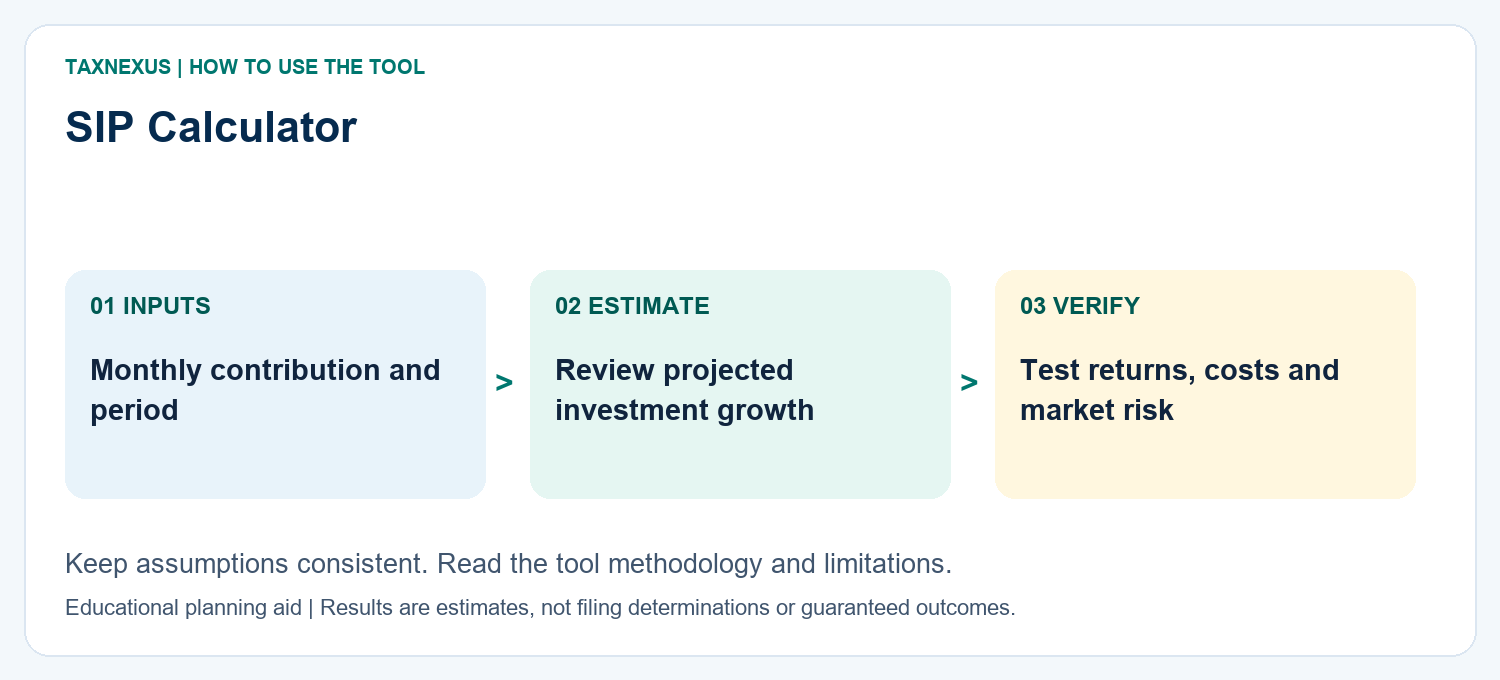
How to read your SIP result
Compare total invested amount with the projected maturity value and estimated gain. The result assumes a constant return for illustration, while real mutual fund returns vary over time.
Planning note: Test conservative, moderate and optimistic return assumptions instead of relying on one projection.
Need help comparing scenarios or want a custom finance worksheet? Contact TaxNexus and tell us what you are trying to calculate.
Ask TaxNexus
Send your question and the TaxNexus team can review what you are trying to calculate. The calculator page is included automatically.
Safety: Do not send passwords, OTPs, card numbers, bank login details or other confidential credentials.