Lumpsum Calculator
Explore the projected growth of a one-time investment with your own return and inflation assumptions.
Annual compounding: future value = initial investment × (1 + annual return) raised to the number of years. This differs from the monthly-compounding convention on our SIP calculator.
Inflation is an editable planning assumption, not a forecast.
Year-by-year wealth breakdown
Initial investment in blue; projected gains in teal.
Year-by-year growth schedule
| Year | Initial investment | Cumulative gains | Year-end balance | Inflation-adjusted |
|---|
Educational projection. Actual investment returns vary and capital can fall. Constant assumed returns do not model market volatility. Results exclude taxes, exit loads and other charges. Future value is not guaranteed.
Compare: SIP Calculator · SWP Calculator
Lumpsum Calculator: Estimate how a one-time investment may grow over time using an assumed annual return. Enter the investment amount, expected return and time period to see projected gains and total value.
Lumpsum Investment Example
For example, if you invest ₹1,00,000 once and assume a 12% annual return for 10 years, the calculator estimates the future value using annual compounding. You can change the amount, rate and period to compare multiple scenarios.
Lumpsum Calculator FAQs
What is a lumpsum investment?
A lumpsum investment is a one-time investment made upfront rather than through regular monthly contributions.
How is the projected value calculated?
The calculator uses compound growth based on the investment amount, expected annual return and investment period. The result is an estimate, not a guaranteed return.
Lumpsum vs SIP: what is the difference?
A lumpsum investment deploys the amount at one time, while an SIP invests smaller amounts at regular intervals. The suitable approach depends on cash availability, investment horizon and risk tolerance.
Related Calculators
Compare regular investing with the SIP Calculator, test withdrawal plans with the SWP Calculator, or browse all Finance Calculators.
What is a Lumpsum Investment?
Lumpsum investment or one-time investment is a style of investment in which you invest once (lumpsum) and allow your invested money to generate compounding returns over a given time frame.
What Is Lumpsum Calculator?
A Lumpsum Calculator projects the future value of a one-time amount under a constant assumed return. It does not predict market performance. Long periods can magnify small changes in the return assumption, so compare several scenarios and avoid treating an optimistic projection as a target that will necessarily be achieved.
How does this Lumpsum Calculator work?
Our lumpsum calculator is so convenient to use that even a layman can use it. In our Lumpsum Calculator, you need to just enter the required inputs such as the amount you are willing to invest, the time period (in years) you are willing to stay invested and, the expected rate of return per annum that you think the investment will generate. After entering the required variables, the calculator will give you the future value of your investments.
The formula that we have used in this Lumpsum Calculator is: Value = Investment × (1 + R)N, where R is the annual return as a decimal and N is the number of years
When should one prefer Lumpsum Investment?
The decision depends on available surplus, goals, time horizon, liquidity needs and risk tolerance. Money needed for near-term obligations should be considered separately. An expectation that the market will not fall after investing is not a reliable planning assumption.
What’s the difference between Lumpsum and SIP?
In lumpsum investment one needs to invest only once whereas, in SIP or Systematic Investment Plan one invests a fixed amount periodically. In lumpsum investment style the market condition plays a huge role because if the market makes a major correction after your investment, then it might take few years to reach your original investment amount. Whereas, in SIP or systematic investment style purchases are spread across dates and market levels. This changes exposure to the entry date but does not remove market risk or guarantee a profit.
Where can I park my funds for Lumpsum investment?
For lumpsum investment one can choose various instruments like Mutual Funds, Equity Shares, Exchange Traded Funds, Liquid Funds, Bonds, Fixed Deposits etc. But again, we think that you should select these instruments for lumpsum investment only after considering your risk profile, financial goals, liquidity needs etc.
Lumpsum Calculator: 3 essential scenario checks
- Compare the same investment over different periods without changing the assumed return.
- Test a lower return and review whether the projected result still supports the planning goal.
- Keep fees, taxes and liquidity needs separate from the gross growth illustration.
Read SEBI’s investor education resources and the selected product’s documents before deciding how to invest.
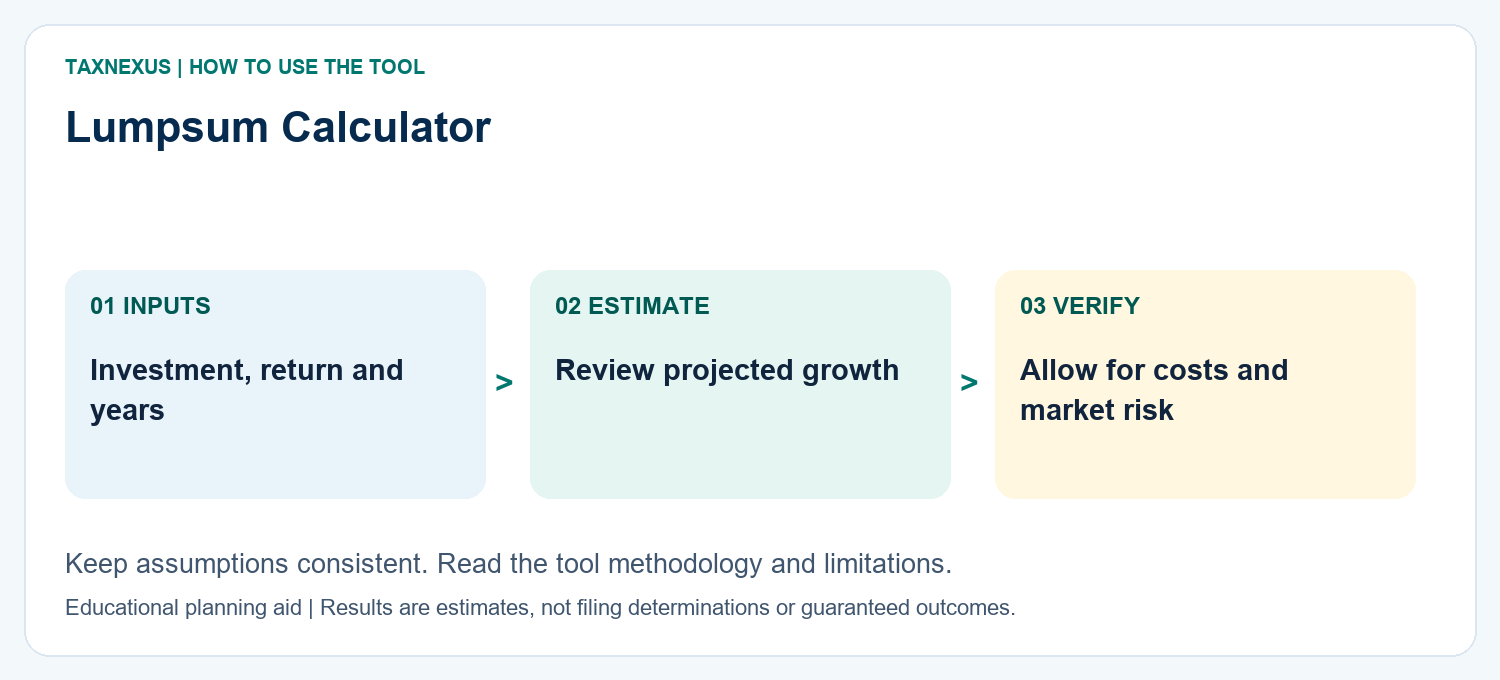
How to read your lump-sum result
Your projected value shows how a one-time investment may grow under the return and time assumptions you entered. Market-linked returns are not guaranteed and can vary substantially.
Planning note: Use multiple return scenarios and match the investment horizon to your financial goal.
Need help comparing scenarios or want a custom finance worksheet? Contact TaxNexus and tell us what you are trying to calculate.
Ask TaxNexus
Send your question and the TaxNexus team can review what you are trying to calculate. The calculator page is included automatically.
Safety: Do not send passwords, OTPs, card numbers, bank login details or other confidential credentials.