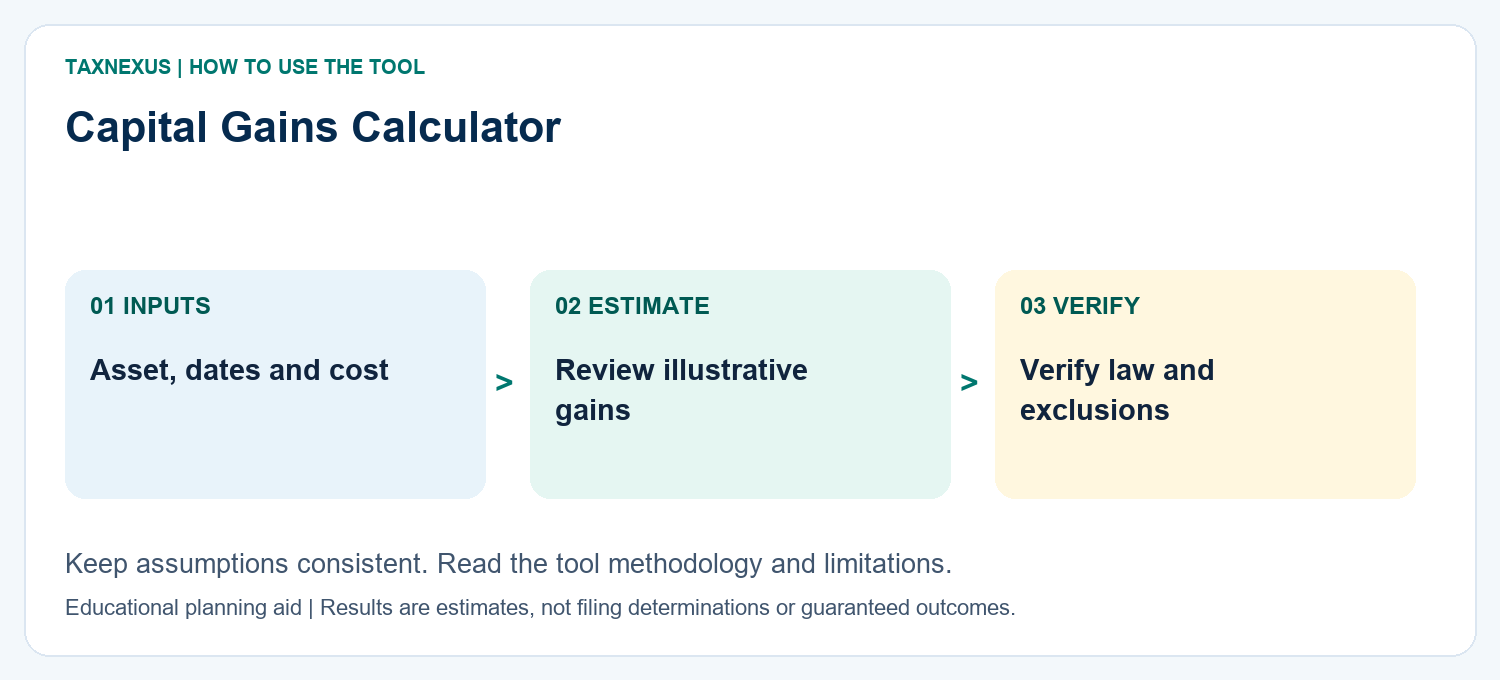
Capital gains planning starts with the asset facts and the applicable tax period. Use the calculator for an indicative comparison, then review the adjustments and exclusions before preparing a return.
Capital Gains & VDA Calculator
Estimate tax on listed equity, property, other capital assets and virtual digital assets.
Before using this estimate
Identify the asset, acquisition and transfer dates, holding period, taxpayer status and the tax period before choosing an asset category. The tool is a simplified planning aid. It is not a substitute for the schedules in the applicable income-tax return and cannot decide whether a transaction qualifies for a particular tax treatment.
Prepare the inputs
Use documented sale consideration, acquisition cost and qualifying transfer expenses. Keep separate working papers for each asset. A brought-forward loss should be entered only after checking its nature, availability and permitted use; a field accepting an amount is not confirmation that the loss may be used. Special rules for virtual digital assets need a separate review.
Arithmetic example
If an illustrative asset is sold for ₹2,00,000, with recorded cost of ₹1,20,000 and qualifying transfer expenses of ₹5,000, the simple difference is ₹75,000 before any applicable statutory adjustments. This example explains the arithmetic only. It does not select a tax rate, holding-period treatment, exemption or eligible loss for that asset.
Check what the result leaves out
Review the rate guide and the dates it refers to. Residential status, basic-exemption adjustments, surcharge, cess, indexation options, grandfathering and loss restrictions may change the final liability. A gain computed for one transaction may also need to be combined with other transactions for the year. Do not treat the displayed figure as a final payment instruction.
Use the correct legal framework
Some labels and section references on this tool use the Income-tax Act, 1961 framework. The Income-tax Act, 2025 applies from 1 April 2026; confirm the applicable period and corresponding provisions before using an estimate for a later transaction. The presence of a date input does not mean every subsequent law change is automatically supported.
Check the Income Tax Department and its new Act guidance. Explore the reinvestment planner for a separate preliminary comparison, subject to its eligibility limits. Seek a qualified review before filing.
Capital gains: 5 essential working-paper checks
- Identify the transaction. Keep the acquisition and transfer evidence together and confirm which asset category actually applies.
- Reconcile consideration and costs. Distinguish the amount received from the amount reportable under the applicable rules. A bank receipt alone may not explain every adjustment.
- Review expenses separately. Keep evidence and the basis for treating each expense as eligible rather than deducting every transaction-related payment automatically.
- Track losses and exemptions. Maintain a separate schedule showing their nature and legal availability. The same amount should not be used twice across transactions.
- Review the annual position. Combine the relevant working papers for the year and compare the estimate with the correct return schedules. Do not assume one transaction’s result is the final annual tax.
Keep capital gains and VDA review notes distinct where different rules apply.