SWP Calculator
Plan monthly withdrawals and track how your remaining investment may change over time.
Growth is applied monthly at annual rate ÷ 12, followed by an end-of-month withdrawal. Withdrawals stop when the corpus is exhausted; the final payment may be smaller.
Inflation is an editable planning assumption, not a forecast.
Year-by-year withdrawals and balance
Cumulative withdrawals in blue; remaining corpus in teal.
Year-by-year withdrawal schedule
| Year | Opening balance | Yearly growth | Withdrawn in year | Total withdrawn | Year-end balance | Inflation-adjusted |
|---|
Educational projection. Actual investment returns vary and capital can fall. Constant assumed returns do not model market volatility or sequence-of-returns risk. Results exclude taxes, exit loads and other charges. A withdrawal contains both capital and any realised gain; it is not wholly taxable income.
Compare: SIP Calculator · Lumpsum Calculator
SWP Calculator: Estimate how long an investment may support regular monthly withdrawals and see the projected remaining value. Enter your starting investment, withdrawal amount, expected annual return and withdrawal period. Results are illustrative because market returns are not guaranteed.
A Systematic Withdrawal Plan (SWP) lets an investor redeem a chosen amount from a mutual-fund investment at regular intervals, such as monthly or quarterly. Each withdrawal is funded by redeeming units at the prevailing NAV, so the number of units sold changes with market prices. The remaining investment continues to move with market performance.
What is the SWP Calculator?
The SWP calculator models a starting investment that earns an assumed monthly return while a fixed amount is withdrawn each month. It shows the total amount withdrawn and the estimated balance remaining after the selected period. It is useful for comparing withdrawal scenarios, but it does not predict actual mutual-fund returns.
How Does an SWP Calculator Work?
This calculator applies the assumed annual return on a monthly basis, adds that month’s estimated growth to the current balance, and then deducts the chosen monthly withdrawal. The process repeats until the selected period ends or the balance reaches zero. This matches the calculation used by the tool above.
SWP Calculator Example
For example, if you start with ₹10,00,000, withdraw ₹10,000 per month, assume a 10% annual return and continue for 10 years, the calculator estimates the total withdrawn and the remaining balance based on that constant-return assumption.
SWP Calculator FAQs
Can an SWP provide guaranteed monthly income?
No. The withdrawal instruction may be fixed, but the investment value is market-linked. If returns are weak or withdrawals are high, the balance can fall faster than expected.
Can the investment run out during an SWP?
Yes. If withdrawals plus market losses exceed the investment’s growth, the balance can eventually reach zero. The calculator stops withdrawals once the simulated balance is exhausted.
Does the expected return stay constant in real life?
No. Mutual-fund returns fluctuate. The calculator uses a constant assumed rate only to create an easy-to-understand projection.
Is tax included in the SWP calculation?
No. Mutual-fund withdrawals can have tax consequences depending on the fund category, holding period and applicable tax rules. This calculator does not deduct capital-gains tax or other charges.
What withdrawal rate should I use?
There is no single suitable withdrawal rate for everyone. Test multiple scenarios using different returns, withdrawal amounts and time periods rather than relying on one projection.
Related Calculators
Build an investment first with the SIP Calculator or Lumpsum Calculator, and explore all Finance Calculators.
SWP Calculator: 3 essential scenario checks
- Reduce the assumed return. Compare the same withdrawal under a lower growth assumption. A projection that looks comfortable at one rate may show a much smaller remaining balance at another.
- Change the withdrawal amount. Separate essential spending from optional spending in your household plan. Test how a higher monthly withdrawal changes the remaining corpus without assuming the investment will compensate automatically.
- Review the model limitation. A constant monthly return smooths out market movements. Real losses early in the withdrawal period can affect the outcome differently from the same losses later. This tool does not simulate that full sequence.
For general investor education, read SEBI’s investor resources and the selected fund’s current documents. A withdrawal schedule is not a guaranteed return or a substitute for a cash reserve.
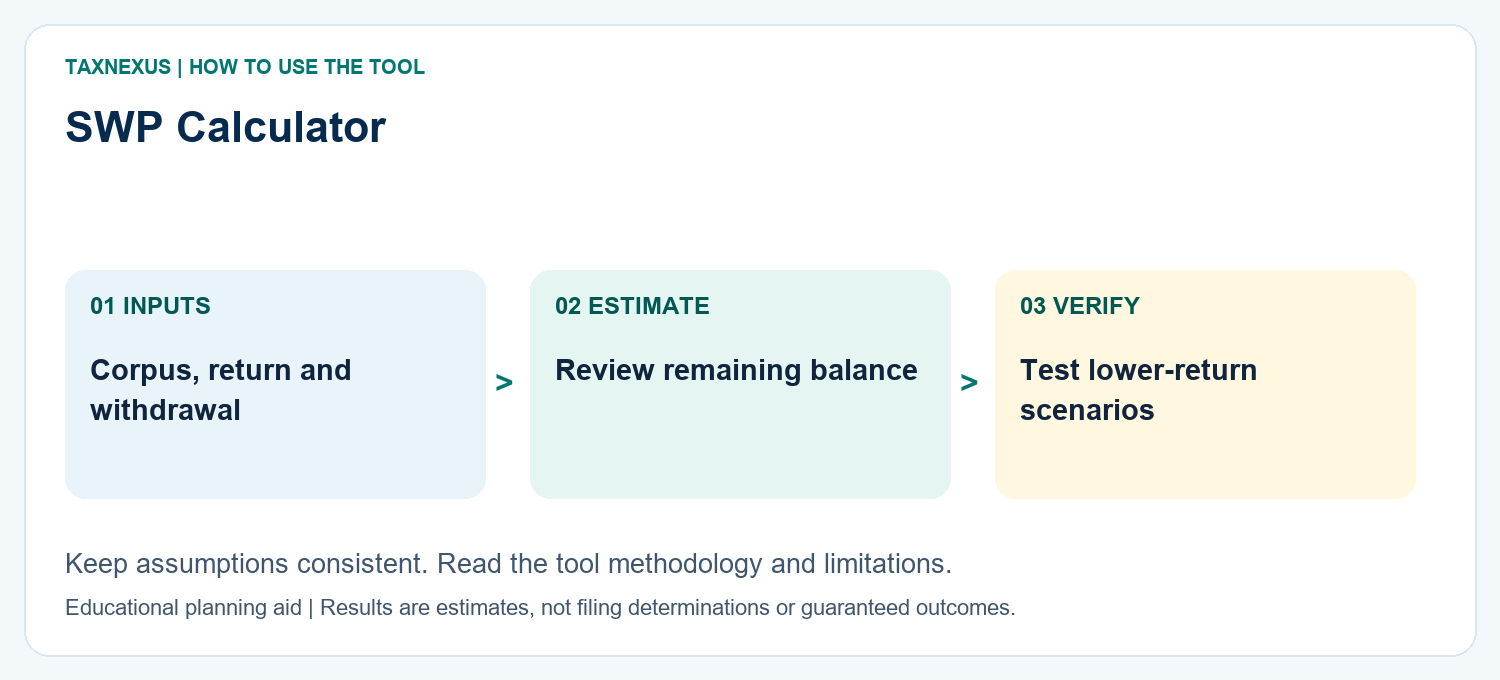
How to read your SWP result
Review total withdrawals together with the remaining investment balance. A higher withdrawal can reduce the portfolio faster, especially when actual returns are lower than the assumed rate.
Planning note: For retirement planning, test lower-return scenarios and longer withdrawal periods.
Need help comparing scenarios or want a custom finance worksheet? Contact TaxNexus and tell us what you are trying to calculate.
Ask TaxNexus
Send your question and the TaxNexus team can review what you are trying to calculate. The calculator page is included automatically.
Safety: Do not send passwords, OTPs, card numbers, bank login details or other confidential credentials.