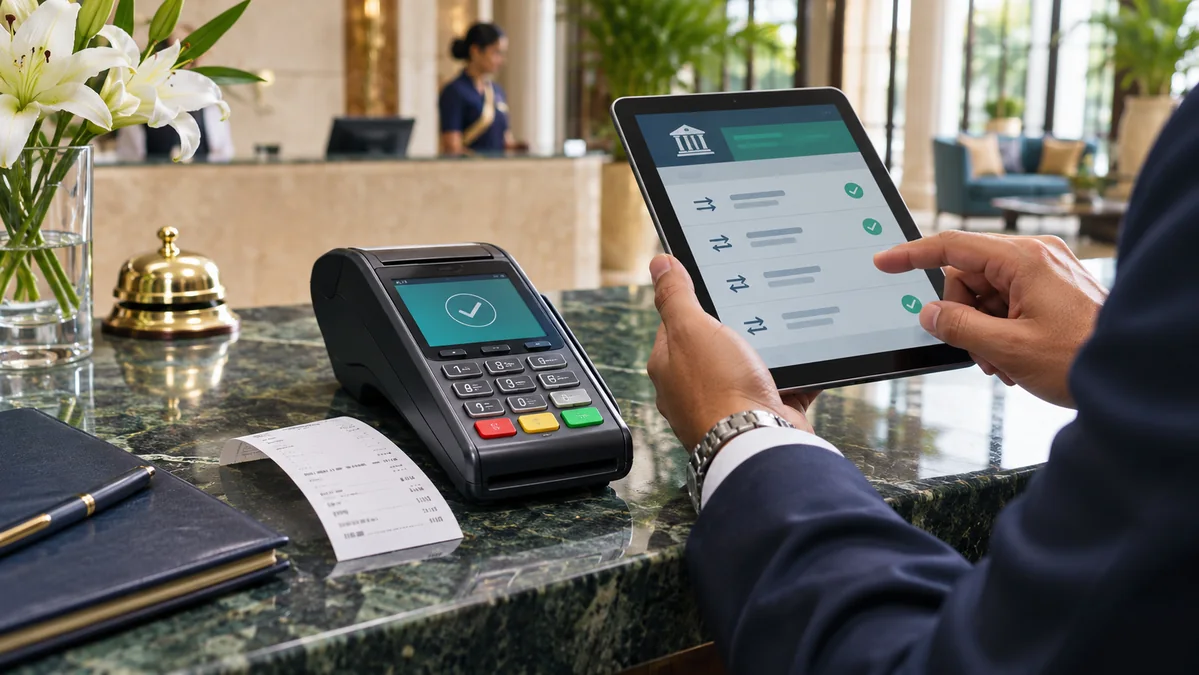
A guest’s card payment can appear in the PMS today and reach the hotel’s bank account later. The amount arriving may also differ from the guest payment because of refunds, processing fees or a documented withholding. Hotel payment settlement reconciliation explains what was collected, what the payment partner settled and what is still due.
Keep this exercise separate from the daily revenue check. A collection may settle an older receivable or represent an advance for a future stay. Revenue and bank receipts therefore need different comparisons.
Keep the three dates visible
Record the hotel business date, transaction date and bank value date. The hotel’s business date may close after midnight, while an acquirer groups transactions by its own cutoff. Match the property, merchant ID, payment provider and currency before comparing totals. Avoid combining different merchants merely because their money reaches the same bank account.
- PMS cashier report or payment register with payment references.
- Acquirer or gateway transaction and settlement reports with batch IDs.
- Bank statement with value date and UTR or settlement reference.
- Refund, chargeback, fee and reserve records supporting deductions.
- OTA booking statements showing which party collected the guest payment.
A card settlement worked example
| Settlement batch S-061 | Amount |
|---|---|
| Captured guest payments | ₹1,20,000 |
| Less refunds included in this batch | ₹5,000 |
| Net payment balance before fees | ₹1,15,000 |
| Less documented processing fees | ₹2,000 |
| Less tax on those fees in this example | ₹360 |
| Expected bank credit | ₹1,12,640 |
| Actual bank credit | ₹1,12,640 |
| Unexplained settlement difference | ₹0 |
The fee and tax figures above are example amounts from an assumed settlement statement. Use the provider’s actual invoice and contract for your working. Check whether each refund has already reduced the transaction total before subtracting it. Deducting a netted refund twice understates the expected bank receipt.
Post the clearing movement once
Assume the PMS has already moved the net ₹1,15,000 to the card clearing account after refunds. A simplified settlement entry is Bank Dr ₹1,12,640, processing fee expense Dr ₹2,000, eligible input tax Dr ₹360 and card clearing Cr ₹1,15,000. If the fee tax is not recoverable, its classification changes. Check eligibility and the invoice before using an input-tax account.
This entry clears a payment receivable. Recording the bank credit as fresh room revenue would duplicate revenue already posted through the guest folio. Check how your PMS interface and ERP handle settlement entries before posting manually.
UPI and OTA receipts need their own matching rules
For UPI, compare the successful transaction list with the settlement report and bank references. Investigate pending, failed, reversed and refunded items using the provider’s final status. A guest screenshot helps locate a transaction, but confirm it in the merchant records before clearing the amount.
For OTAs, first identify whether the guest paid the hotel directly, the OTA collected and remits later, or the hotel charges a virtual card. Match booking ID, stay dates, folio and settlement reference. Separate commission, refunds and documented tax deductions. Whether commission is invoiced separately or netted from a remittance depends on the agreement and statement. Do not assume the net remittance is the hotel’s revenue.
Roll forward the unsettled balance
Suppose opening payment clearing is ₹30,000, new net collections are ₹1,15,000 and a batch clears ₹1,15,000 through bank receipts and documented deductions. Closing clearing is ₹30,000. List the transactions making up that balance and their expected settlement dates. Where refunds are shown as separate movements, use gross new collections and subtract refunds separately so the roll-forward uses each item once.
Give old items an owner and next action. Common reasons include a batch not submitted, settlement to another account, reference mapping errors, a reserve hold or a refund posted to the wrong date. Close the file with the batch report, bank proof, deduction evidence and reviewer approval. Do not clear an unexplained amount to fees simply to make the account balance.
- Oracle Hospitality cashier closure documentation
- Bank reconciliation
- Hotel daily revenue checklist
- Accounts receivable month-end close
Prepared by the TaxNexus Editorial Team. Last reviewed 6 November 2026. All amounts and business records in the worked examples are illustrative. Apply your organisation’s accounting policies and review the applicable tax treatment before posting entries.