Hotel F&B cost control starts with a simple question. Does the food used by the kitchen agree with the food the restaurant should have used for its sales? A month-end stock count gives you one side of that comparison. Point-of-sale quantities and standard recipes give you the other.
This fictional example follows one hotel restaurant for one month. It covers food ingredients and net food sales of ₹16,00,000, excluding GST. Beverage sales and costs are outside the example. Use the same outlet, dates and cost scope on both sides of the calculation.
1. Calculate actual food cost from stock movements
Add opening stock, net purchases received and transfers in. Subtract transfers out and closing stock. In this example the opening and closing counts include food held in the outlet and its assigned storage locations. Net purchases include only receipts for this outlet and period, adjusted for returns. A central-store transfer is entered once as a transfer, even if finance can trace the ingredients back to a supplier invoice.
| Stock movement | Amount |
|---|---|
| Opening food stock | ₹1,80,000 |
| Net food purchases | +₹4,60,000 |
| Transfers in | +₹20,000 |
| Transfers out | −₹10,000 |
| Initial closing count | −₹1,50,000 |
| Initial actual food cost | ₹5,00,000 |
Divide actual food cost by net food sales and multiply by 100. The initial food cost percentage is ₹5,00,000 ÷ ₹16,00,000 × 100 = 31.25%. Use the hotel’s stock valuation method consistently and confirm receipts and transfers around the cut-off. If a delivery arrived before month-end and its invoice arrives later, trace it to the goods receipt and the relevant accrual.
2. Estimate theoretical food cost from POS sales and recipes
Export quantities of food items sold from the point-of-sale system. Match each item to the recipe version in use during the period. Multiply the quantity sold by the standard recipe cost and sum the results. If 400 portions of a dish were sold and the standard food cost is ₹180 per portion, the expected ingredient cost for that dish is ₹72,000.
Check how the POS export handles voids, refunds and complimentary items. A void before preparation usually has no ingredient usage. A dish returned after preparation can still consume food, so it needs an appropriate waste or exception record. Decide which items are included in the theoretical baseline and keep evidence for items explained separately.
Theoretical food cost in this example is ₹4,70,000, or 29.38% of net food sales. The initial variance is ₹30,000. If actual ingredient prices differ from the recipe costing assumptions, check purchase prices separately from physical usage. Use the same unit conversions for packs, kilograms and portions. Oracle’s actual versus theoretical variance reporting guide
3. Recount stock and explain the variance
The stock team finds ₹8,000 of ingredients omitted from the closing count and validates them against signed recount sheets. Corrected closing stock becomes ₹1,58,000. Actual food cost falls to ₹4,92,000, or 30.75% of net food sales. The corrected cost remains ₹22,000 above theoretical, a gap of approximately 1.38 percentage points calculated before rounding.
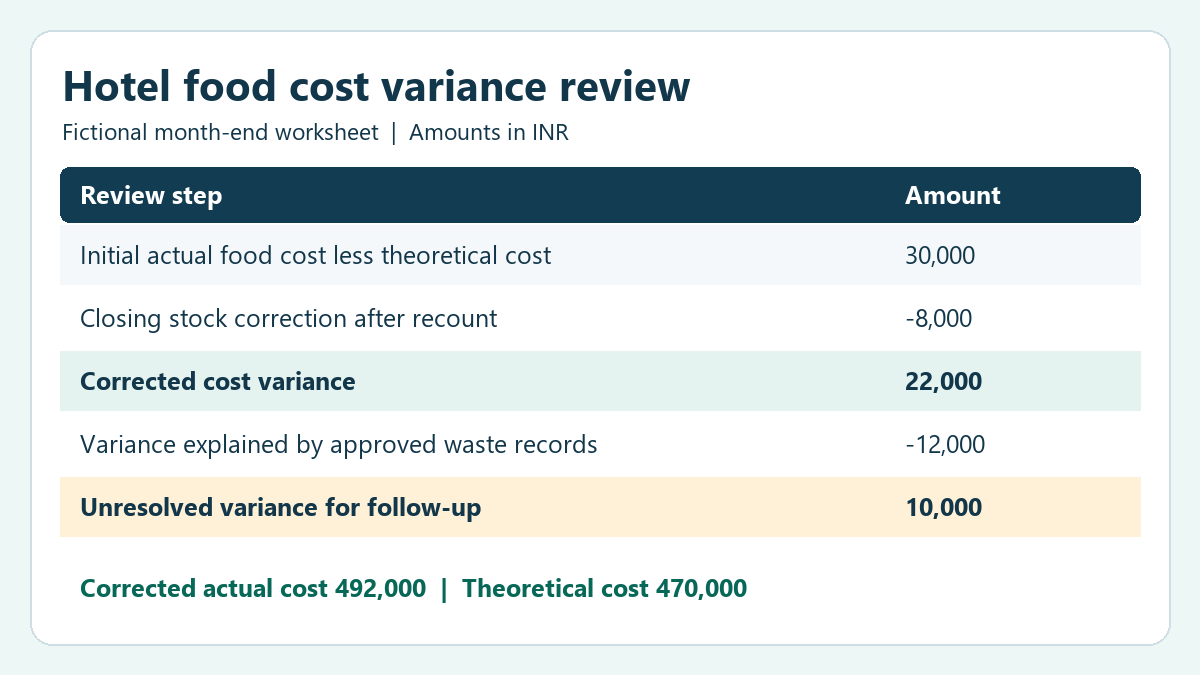
Approved waste records explain ₹12,000 of the corrected variance. That waste is already reflected in the cost derived from stock movements, so use it to explain the variance in the review. The remaining ₹10,000 is unresolved. Assign it to the chef and cost controller to review portion yields, late transfers, receiving quantities and high-variance ingredients. Keep the open amount in the close record until the evidence explains it.
4. Review high-variance ingredients first
Sort the ingredient report by the size of the unexplained value. For a high-cost item, compare actual quantity consumed with the recipe quantity expected for sales. Then check supplier pack sizes, the count unit and the recipe unit. A carton entered as one kilogram can distort both received quantity and the cost assigned to each portion.
Trace any transfer across both locations. Check the date, quantity and receiving outlet. If one outlet posted a transfer out and the receiving outlet missed the transfer in, the property total can still mask a departmental problem. Ask both outlet owners to confirm the same movement reference and retain their approval with the close file.
Use the hotel F&B cost control review to decide whether the remaining gap comes from price, usage or a record that needs correction. Ask the kitchen to test portion sizes and yields when usage appears high. Ask purchasing to check invoices when actual ingredient cost per unit has moved. Assign a date and owner to each follow-up.
5. Sign off the hotel F&B cost control review
- Match opening stock to the prior signed closing count.
- Confirm receipts, returns and transfers around month-end.
- Recount significant discrepancies and retain the signed corrections.
- Tie net food sales to the outlet’s POS and finance reports.
- Check recipe quantities, yields, unit conversions and costing dates.
- Reconcile actual usage to theoretical cost and document the remaining difference.
File the stock count, sales export, recipe cost version and variance explanation together. Use the next hotel F&B cost control review to confirm whether the actions reduced the recurring gap. A named owner and review date make it easier to distinguish a resolved count error from an operating issue that still needs attention.
How to write the month-end variance note
Start with the corrected cost and explain each adjustment in order. For this hotel F&B cost control example, record that the recount increased closing stock by ₹8,000 and reduced the reported cost by the same amount. Then identify the ₹12,000 supported by approved waste records and leave the remaining ₹10,000 open for investigation. Attach the count sheets and waste log so the reviewer can follow the figures.
Set the next review date and name the people responsible. The chef can compare portion sizes and production yields for the ingredients with the largest remaining differences. The cost controller can trace late receipts and transfers to the next period and check whether any require an approved correction. Bring the results into the next hotel F&B cost control meeting and retain the evidence with the original variance note.
Related TaxNexus guides
Build the outlet sales forecast from covers and average spend. Hotel Budgeting and Forecasting
Check that food inventory, transfers and outlet costs flow to their intended reporting lines. Hotel Chart of Accounts Mapping
Trace point-of-sale totals before using them in the cost review. Hotel Daily Revenue Reconciliation Checklist