FD Calculator
Compare contributions, estimated interest and projected balances using your own savings assumptions.
Cumulative fixed deposit illustration: principal × (1 + annual rate ÷ compounding frequency) raised to frequency × years. Assumes interest is reinvested. Bank day-count, rounding, premature withdrawal and payout terms can change the actual maturity amount.
Inflation is an editable planning assumption, not a forecast.
Year-by-year wealth breakdown
Cumulative deposits in soft blue; estimated interest in mint.
Year-by-year growth schedule
| Year | Total deposited | Cumulative interest | Year-end balance | Inflation-adjusted |
|---|
Educational projection. The assumed interest rate is held constant for illustration and may differ from the rate applicable to your account. Values exclude tax, penalties and charges. Check scheme rules or the deposit provider’s actual terms before using a projection.
Explore all Savings & Deposits calculators.
FD Calculator: Estimate fixed-deposit maturity value and interest by entering the deposit amount, annual interest rate, tenure and compounding frequency. Actual returns can vary by bank, deposit type, payout option and tax treatment.
A Fixed Deposit (FD) is a deposit placed with a bank or eligible financial institution for a chosen tenure at an agreed interest rate. An FD calculator helps estimate maturity value and interest for different deposit amounts, rates, tenures and compounding frequencies. The result is an estimate and should be compared with the terms offered by the institution.
FD Calculator Example
For example, a deposit of ₹1,00,000 for 5 years at 7% p.a. with quarterly compounding gives an illustrative maturity value of about ₹1.41 lakh. Change the interest rate, tenure or compounding frequency to compare different FD offers.
FD Calculator FAQs
How is FD maturity calculated?
For cumulative fixed deposits, maturity depends mainly on the principal, annual interest rate, tenure and compounding frequency. Non-cumulative deposits can pay interest periodically instead of adding it to the principal.
Does compounding frequency affect FD returns?
Yes. If the quoted annual rate is otherwise the same, more frequent compounding can slightly increase the maturity value. Always use the compounding method stated by the bank or institution.
Do senior citizens get higher FD interest rates?
Many banks offer an additional interest rate to eligible senior citizens, but the extra rate, age criteria and eligible deposit types vary by institution. Enter the actual rate offered to you in the calculator.
Is TDS deducted on FD interest?
FD interest can be subject to income-tax and TDS rules depending on the depositor, institution and applicable thresholds. This calculator shows gross estimated interest and does not deduct tax automatically.
Is the FD maturity value guaranteed by this calculator?
No. The calculator is only an estimate. The institution’s actual rate, compounding method, premature-withdrawal rules, tax treatment and product terms determine the final amount.
Related Calculators
Compare fixed deposits with the RD Calculator, review long-term savings with the PPF Calculator, or browse all Finance Calculators.
How Can FD Calculator Help you?
Determining the maturity amount for a fixed deposit (FD) can often be complex and time-intensive. However, with an online FD calculator, you can compute these amounts effortlessly.
- A fixed deposit calculator simplifies maturity planning by providing an instant estimate based on the amount, rate, tenure and compounding frequency you enter.
- This tool significantly reduces the time spent on these elaborate calculations.
- An FD return calculator also allows you to compare the maturity sums and interest rates provided by different banks or financial entities. Having access to this detailed information helps you make well-informed financial decisions.
How Does FD Calculator Work?
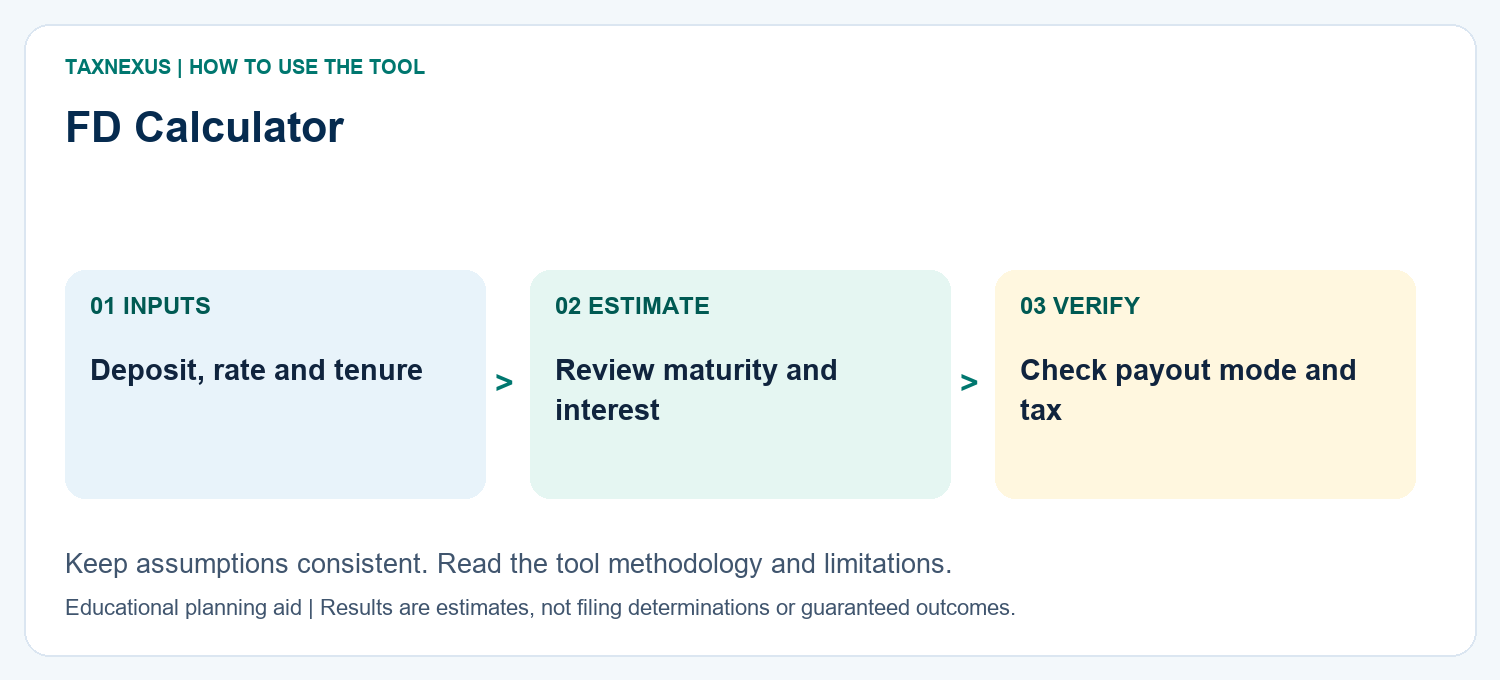
To use an FD (Fixed Deposit) Calculator, you simply need to enter three key details: the deposit amount, the investment duration (in months or years), and the applicable interest rate, along with selecting the compounding frequency—monthly, half-yearly, or annually. Once these inputs are provided, the calculator uses the compound interest formula to determine the maturity amount. This amount includes both your principal investment and the total interest earned over the selected tenure, giving you a clear picture of your returns.
How To Calculate Fixed Deposit Maturity Amount
FD compounding frequency depends on the bank and deposit product. Common options include monthly, quarterly, half-yearly and yearly compounding. For compound-interest deposits, the maturity value can be estimated using the standard compound-interest formula:
A = P * (1+ r/n) ^ n*t ,
Where ,
- I = A – P
- A = Maturity value
- P = Principal amount
- r = annual interest rate as a decimal (for example, 7% = 0.07)
- t = Number of years
- n = Compounded interest frequency
- I = Interest earned amount
Example Of FD Calculation
For a separate arithmetic illustration, assume ₹3,00,000 earns simple interest at 6.5% per annum for two years. This is not a quoted bank offer and does not use compounding.
Using the simple interest formula:
Maturity Amount = Principal + (Principal * Rate * Tenor)
= 3,00,000 + (3,00,000 * 0.065 * 2)
= 3,00,000 + 39,000
= Rs. 3,39,000
Under these simple-interest assumptions, principal plus interest is ₹3,39,000. A cumulative FD with compounding can produce a different maturity value.
Review the institution’s calculation method before comparing offers. SBI’s interest-rate guidance, for example, distinguishes reinvestment deposits from deposits paying interest periodically. Use the terms of your selected product rather than assuming the same convention applies everywhere.
How to read your FD result
Review principal, interest earned and maturity amount together. The final bank payout can vary with the exact compounding method, tenure conventions, premature closure and tax treatment.
Planning note: Confirm the deposit rate and compounding terms with the bank before investing.
Need help comparing scenarios or want a custom finance worksheet? Contact TaxNexus and tell us what you are trying to calculate.
Ask TaxNexus
Send your question and the TaxNexus team can review what you are trying to calculate. The calculator page is included automatically.
Safety: Do not send passwords, OTPs, card numbers, bank login details or other confidential credentials.