RD Calculator
Compare contributions, estimated interest and projected balances using your own savings assumptions.
Assumes each monthly deposit is paid at the start of the month. Interest uses quarterly compounding with fractional-quarter growth for the months remaining until maturity. At a 0% rate, the result equals total deposits. Actual bank or post-office accrual, instalment dates, penalties and rounding can differ.
Inflation is an editable planning assumption, not a forecast.
Year-by-year wealth breakdown
Cumulative deposits in soft blue; estimated interest in mint.
Year-by-year growth schedule
| Year | Total deposited | Cumulative interest | Year-end balance | Inflation-adjusted |
|---|
Educational projection. The assumed interest rate is held constant for illustration and may differ from the rate applicable to your account. Values exclude tax, penalties and charges. Check scheme rules or the deposit provider’s actual terms before using a projection.
Explore all Savings & Deposits calculators.
RD Calculator: Estimate recurring-deposit maturity value, total monthly contributions and interest by entering your monthly deposit, tenure and annual interest rate. Actual returns can vary by bank, compounding convention, deposit date and tax treatment.
A Recurring Deposit (RD) allows you to deposit a fixed amount at regular intervals, usually every month, for a chosen tenure. It can be useful for disciplined savings when you prefer periodic contributions instead of investing a lump sum. This calculator provides an estimate of total contributions, interest and maturity value based on the inputs you enter.
What Is a Recurring Deposit (RD)?
Recurring Deposits are savings products offered by banks and other eligible institutions that accept regular instalments for a fixed period. The minimum deposit, available tenure, interest rate, premature-closure rules and compounding method depend on the institution and product.
How Is RD Interest Calculated?
RD interest calculation depends on the institution’s stated compounding convention and the timing of each instalment. Quarterly compounding is common in India, but you should use the method specified by your bank or deposit provider. For a quarterly-compounding illustration, the maturity calculation can be represented as:
M = R[(1+i)^n-1]/(1-(1+i)^(-1/3) )
Where,
- M = Maturity Value
- R = Monthly Installment
- n = Number of quarters
- i = Annual interest rate (%) / 400
For example, if you deposit ₹10,000 per month for 1 year at an assumed 8% p.a., the calculator estimates a maturity value of approximately ₹1,25,293. The exact bank maturity value can differ depending on the deposit dates and compounding method.
RD Calculator FAQs
How is RD maturity calculated?
Each monthly instalment earns interest for a different length of time. The final maturity amount therefore depends on the instalment amount, interest rate, tenure, contribution timing and compounding method.
Is RD interest the same at every bank?
No. RD interest rates and tenure options vary by bank and product. Use the actual rate offered by your institution in the calculator.
Do senior citizens get higher RD interest rates?
Many banks offer additional interest to eligible senior citizens, but the extra rate and eligibility conditions vary. Enter the specific rate offered to you.
Is tax deducted on RD interest?
RD interest can be subject to income-tax and TDS rules depending on the depositor, institution and applicable thresholds. This calculator shows gross estimated interest and does not deduct tax automatically.
Is the maturity value guaranteed?
No. The calculator provides an estimate. The bank’s actual interest rate, deposit dates, compounding convention, missed instalments, premature closure and tax treatment can affect the final amount.
Related Calculators
Compare recurring deposits with the FD Calculator, review long-term savings with the PPF Calculator, or browse all Finance Calculators.
RD Calculator: 5 essential checks before comparing deposits
- Match the instalment amount. Enter the amount planned each month rather than the total you expect to save over the full term. Total contributions are the monthly amount multiplied by the number of instalments.
- Use the offered rate. Check the rate for the chosen tenure and customer category. A promotional headline may apply to a different product or period.
- Compare the timing convention. Each instalment has a different time to maturity. An annual lump-sum formula cannot represent all monthly deposits without adjusting their individual holding periods.
- Check missed-payment and closure terms. The standard projection assumes the planned saving schedule continues. Delayed instalments or premature closure can change the actual proceeds.
- Separate gross interest from spendable proceeds. This RD Calculator does not determine your individual tax or deduct every possible charge. Compare the bank’s final maturity advice with the assumptions you entered.
For an example of product-specific rules, see SBI’s recurring-deposit guidance. Use your own provider’s current terms when making a decision.
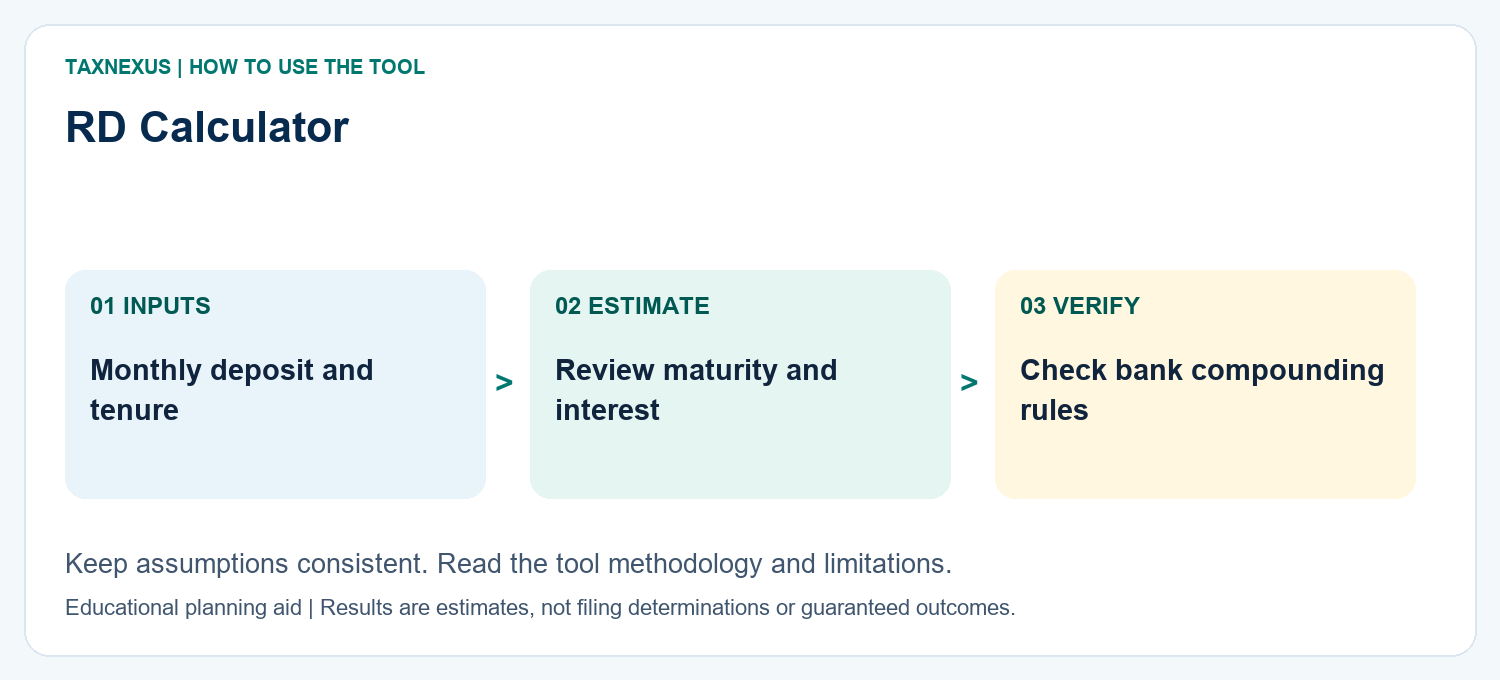
How to read your RD result
The calculator estimates maturity from regular monthly deposits, rate and tenure. Because each instalment earns interest for a different period, the total interest differs from a simple lump-sum calculation.
Planning note: Check the bank’s actual RD rate, compounding method and premature-closure rules.
Need help comparing scenarios or want a custom finance worksheet? Contact TaxNexus and tell us what you are trying to calculate.
Ask TaxNexus
Send your question and the TaxNexus team can review what you are trying to calculate. The calculator page is included automatically.
Safety: Do not send passwords, OTPs, card numbers, bank login details or other confidential credentials.