Loans & EMI Planning in India
Understand EMI, total interest, fixed vs floating rates, prepayment, processing charges and borrower protections before choosing a home, car or personal loan.
Editorial standards: About TaxNexus · Editorial Policy · Disclaimer
A low EMI does not automatically mean a low-cost loan. The real borrowing cost depends on the interest rate, loan tenure, processing and other charges, prepayment behaviour and whether the rate can reset during the loan. Compare the total repayment and not only the monthly instalment.
Home, Car & Personal Loan EMI Calculator
In-Hand Salary Calculator
Salary, Bonus & CTC Calculator
TaxNexus Finance Calculators
1. What determines your EMI?
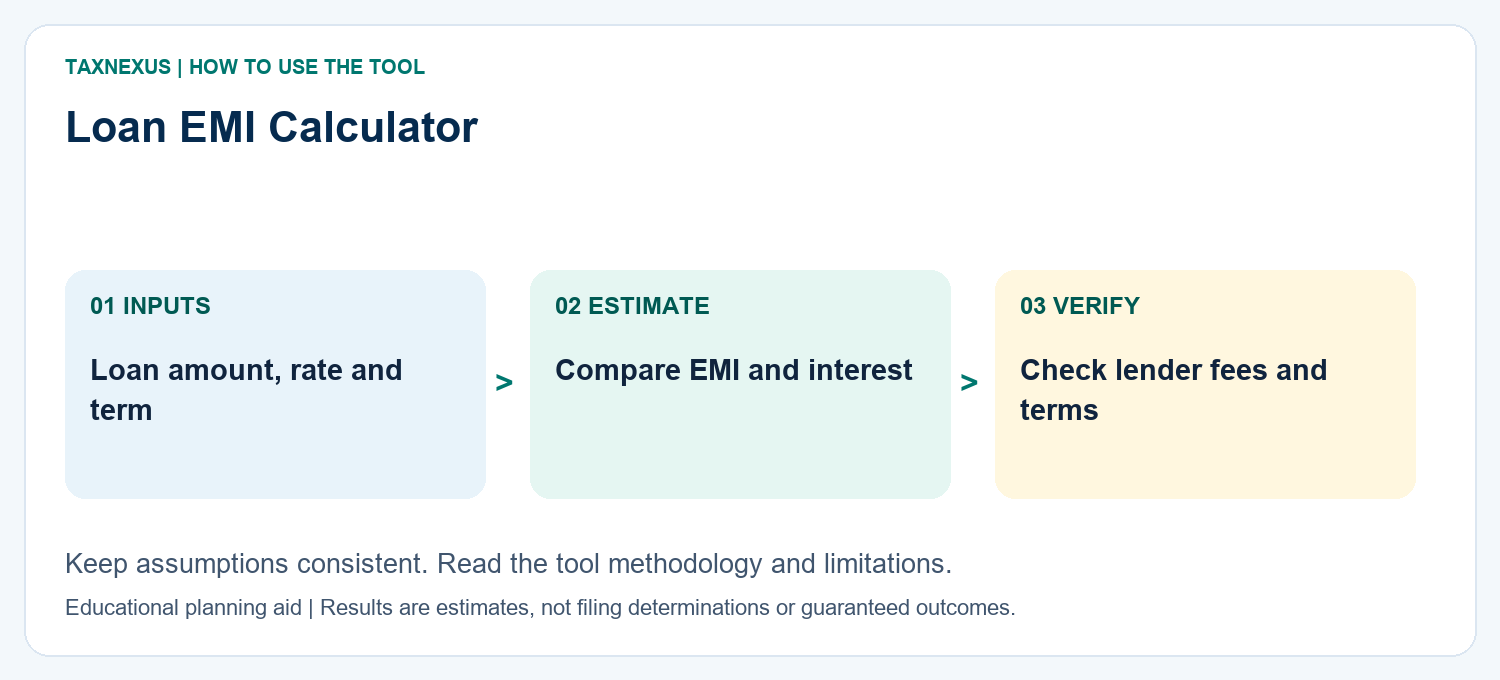
For a standard reducing-balance loan, EMI mainly depends on three inputs: principal, interest rate and tenure. A longer tenure usually lowers the monthly EMI but can materially increase total interest paid.
2. Fixed vs floating interest rate
A fixed-rate loan keeps the contracted rate fixed for the relevant period, subject to the lender’s terms. A floating-rate loan can change when the linked benchmark or lender-approved reference changes.
RBI’s framework for EMI-based personal loans requires regulated entities to communicate the impact of interest-rate resets and provide borrowers with prescribed options. RBI FAQs state that, on a qualifying floating-rate reset, borrowers are to be offered options such as changing the EMI, extending the number of EMIs, using a combination of both, switching to a fixed rate where applicable under the lender’s policy, or prepaying partly or fully.
3. Key Facts Statement and APR
RBI’s fair-practices framework includes a Key Facts Statement for loans and advances. A borrower should review the interest rate, annual percentage rate or total cost indicators where provided, repayment schedule, processing charges, insurance or other bundled charges, prepayment terms and penalties before accepting the loan.
4. Processing fee and other costs
Loan cost can include more than interest. Depending on the lender and product, charges may include processing fees, documentation, valuation, legal checks, insurance, switching charges and statutory charges. Ask which charges are refundable and which are not.
The TaxNexus Loan Calculator lets you model a processing-fee percentage separately so you can compare the EMI with the broader borrowing cost.
5. Prepayment: when can it help?
Prepayment reduces outstanding principal. When done earlier in the tenure, it can reduce future interest more strongly because more interest would otherwise accrue on the higher balance. The result depends on the rate, timing, prepayment amount and lender terms.
Use the Loan Calculator to model a one-time prepayment and compare estimated interest savings and revised tenure.
6. Home loan planning
- Keep a separate emergency reserve instead of using every available rupee for the down payment.
- Budget for registration, taxes, legal/valuation costs, maintenance and insurance—not only the property price.
- Check whether the quoted rate is fixed, floating or fixed only for an initial period.
- Stress-test the EMI at a higher interest rate before borrowing.
- Review property approvals and lender due-diligence requirements.
RBI guidance for housing finance also emphasises lender checks around sanctioned plans and property documentation for applicable housing loans.
7. Car loan planning
Compare the on-road vehicle cost, down payment, financed amount, interest rate and loan tenure. A long-tenure car loan can leave you paying interest while the vehicle is depreciating quickly. Consider the effect of insurance, maintenance and fuel costs on your overall monthly budget.
8. Personal loans
Personal loans are usually unsecured and can therefore carry a higher rate than secured loans. Compare the actual amount credited to your account after fees with the full repayment obligation. Avoid using only the advertised rate or EMI to compare offers.
9. Penal charges and delayed repayment
RBI’s fair-lending framework says penalties for non-compliance with loan terms should be treated as penal charges, rather than being added as penal interest to the loan interest rate, and penal charges should not themselves be capitalised. The framework applies subject to its scope and exclusions.
Missing EMIs can also affect your credit history and trigger recovery processes, so contact the lender early if repayment difficulty develops.
10. Loan affordability checklist
| Check | Question to ask |
|---|---|
| Monthly cash flow | Can I pay the EMI after essential expenses and savings? |
| Emergency reserve | Can I manage several months of expenses if income stops? |
| Rate risk | What happens if a floating rate rises? |
| Total cost | What is total interest plus fees and other charges? |
| Prepayment | Are there restrictions or charges for part/full prepayment? |
| Tenure | Am I lowering EMI by extending the loan too far? |
11. Common borrowing mistakes
- Comparing only EMI instead of total repayment.
- Ignoring processing fees and bundled costs.
- Taking the maximum eligible loan rather than the affordable loan.
- Assuming floating rates will never rise.
- Using all savings for the down payment and leaving no emergency reserve.
- Refinancing without comparing switching costs and remaining tenure.
12. Official references
For borrower-protection and regulated-lender guidance, use the Reserve Bank of India. Loan terms vary by lender and borrower profile, so read the sanction letter and Key Facts Statement before committing.