Investment & Retirement Planning in India
Build a practical plan across emergency savings, SIPs, lump-sum investing, deposits, PPF, EPF, NPS, SSY and retirement withdrawals.
Editorial standards: About TaxNexus · Editorial Policy · Disclaimer
A useful investment plan starts with the goal, not the product. Define when you need the money, how much loss you can tolerate, how much liquidity you need and what tax treatment applies. Only then choose between market-linked investments, retirement accounts and deposits.
SWP Calculator
1. Start with a financial safety layer
Before chasing long-term returns, many households benefit from maintaining accessible emergency savings for essential expenses and unexpected events. The appropriate amount depends on job stability, dependants, insurance and fixed obligations. Money needed in the near term should generally not be exposed to the same volatility as long-term equity goals.
2. Match investment type to time horizon
| Goal horizon | Typical planning focus |
|---|---|
| Short term | Capital stability, liquidity and known cash-flow needs |
| Medium term | Balance between growth and downside risk |
| Long term | Inflation-beating growth, diversification and disciplined contributions |
| Retirement | Accumulation plus a separate withdrawal-income strategy |
3. SIP vs lump-sum investing
A SIP spreads investments over time and can support disciplined saving from monthly income. A lump-sum investment deploys available capital at once. Neither approach guarantees a higher return: results depend on market performance, asset allocation, fees, taxes and the investment period.
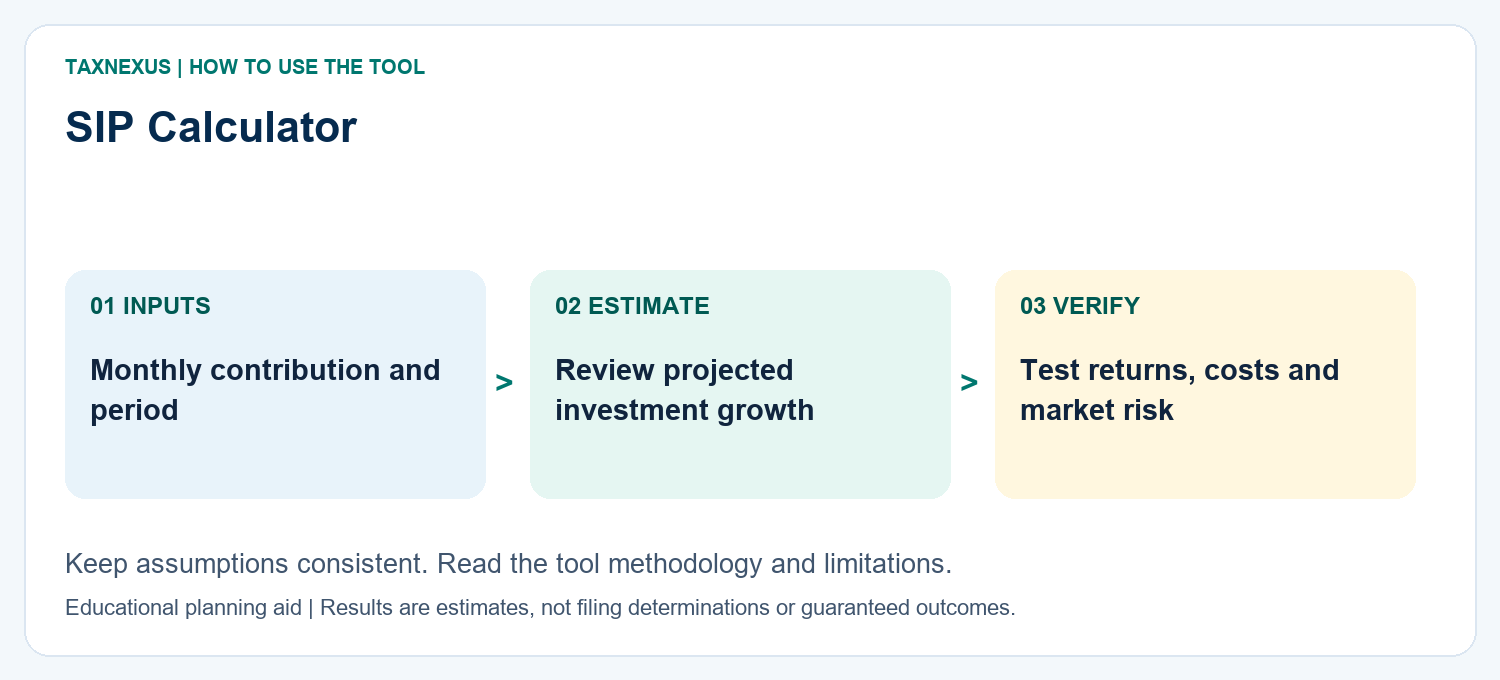
Use the SIP Calculator to model regular contributions and the Lumpsum Calculator to model one-time investing. These are projection tools, not return promises.
4. Systematic withdrawals in retirement
An SWP can model regular withdrawals from an investment portfolio, but withdrawal sustainability depends on actual returns and sequence-of-returns risk. A portfolio that suffers large losses early in retirement can deplete faster than a smooth-return illustration suggests.
Use the SWP Calculator to test multiple withdrawal and return assumptions rather than relying on one scenario.
5. EPF: employment-linked retirement saving
EPF is an important retirement component for covered employees. EPFO’s published contribution guidance shows the standard employee contribution at 12% in covered establishments, subject to the rules and specified exceptions. Employer contributions are allocated under the EPF/EPS framework.
Estimate long-term accumulation with the EPF Calculator, then verify actual payroll contributions in your EPFO records.
6. NPS: retirement corpus and income planning
NPS is a regulated retirement system overseen by PFRDA. Contributions are invested according to the subscriber’s scheme choices and applicable investment framework. Exit and retirement-income options are governed by current NPS regulations and can change over time.
PFRDA introduced additional retirement-income and drawdown options in 2026, so retirement planning should use current PFRDA guidance rather than older withdrawal summaries. Model your accumulation with the NPS Calculator, then confirm exit rules with PFRDA/NPS Trust before acting.
7. PPF and Sukanya Samriddhi
PPF and Sukanya Samriddhi Yojana are long-term Government-backed small-savings schemes with their own eligibility, contribution, maturity and withdrawal rules. Interest rates are notified periodically, so avoid using an old rate indefinitely in planning.
Use the PPF Calculator and SSY Calculator to test contribution scenarios, then confirm the current notified rate and scheme conditions.
8. FD and RD: predictable savings tools
Fixed and recurring deposits are useful when predictability and cash-flow matching matter more than market-linked growth. Compare the stated interest rate, compounding frequency, premature-withdrawal conditions, depositor protection and tax treatment rather than looking only at the headline rate.
Use the FD Calculator and RD Calculator for maturity estimates.
9. Gratuity as part of retirement planning
Gratuity can be an important employment benefit, but it should not be treated as the only retirement corpus. Eligibility and calculation depend on the applicable law and employment facts. Estimate the amount using the Gratuity Calculator and confirm the final settlement with the employer.
10. Asset allocation and diversification
Asset allocation is the mix of equity, debt, cash and other assets chosen for a goal. Diversification reduces dependence on one security, sector or asset class, but it does not eliminate risk. Review the portfolio periodically and rebalance when the allocation moves materially away from the plan.
11. Taxes and costs matter
Investment returns can be reduced by fund expenses, brokerage, taxes, exit loads, account charges and inflation. Tax treatment varies by product and holding period, and tax law can change. Compare post-tax, post-cost outcomes when choosing between alternatives.
12. A simple retirement planning workflow
- Estimate annual retirement spending in today’s money.
- Adjust for inflation and expected retirement date.
- List EPF, NPS, PPF, investments, deposits and other retirement assets.
- Estimate future contributions under conservative return assumptions.
- Separate emergency and near-term retirement cash from long-term growth assets.
- Model withdrawals and test lower-return scenarios.
- Review nomination, insurance and estate-planning documents.
- Revisit the plan annually or after a major life change.
13. Common investment mistakes
- Choosing products before defining the goal and time horizon.
- Assuming calculator returns are guaranteed.
- Keeping all long-term money in one asset class.
- Ignoring liquidity and emergency needs.
- Using outdated interest rates or NPS/EPF rules.
- Ignoring taxes, fees and inflation.
- Taking excessive risk close to a fixed-date goal.
Investment guides
- How to compare mutual funds — check scheme risk, expenses and exit load before using a return projection.
- SIP versus lump-sum investing — compare contribution timing and long-term scenarios.
- Inflation and your savings goals — estimate future costs and compare purchasing power.
- Sequence of returns risk — see how early losses can affect retirement withdrawals.
14. Official references
For investor education and securities-market information, use SEBI Investor. For NPS regulations and circulars, use PFRDA. For provident-fund rules and member services, use EPFO.