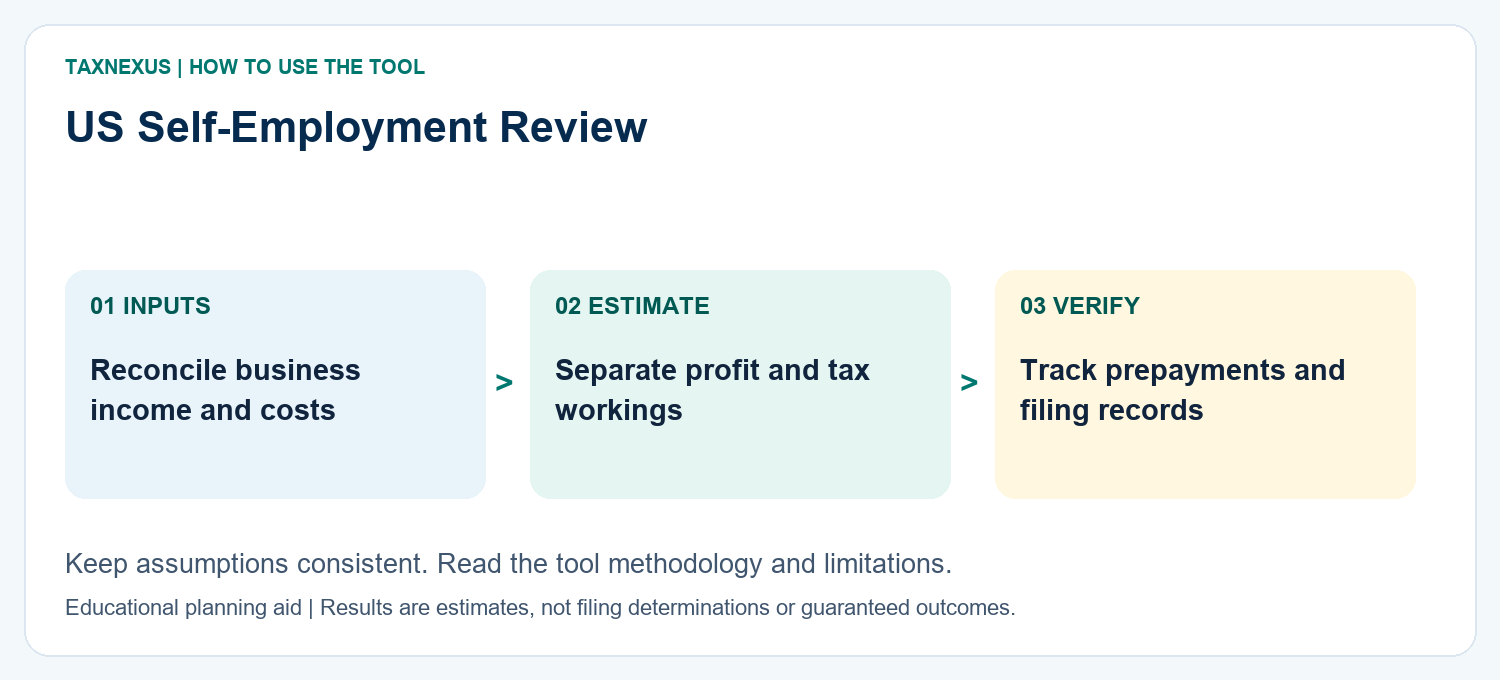
Self-employment tax is one part of a US business owner’s wider filing position. Start with reconciled income and expense records, then review the separate tax calculations and payments already made.
From first 1099 to filing day
A plain-English guide to Schedule C, self-employment tax, estimated payments and the records that make tax season much less stressful.
Working for yourself can be freeing. The tax side can feel less so, especially when your first 1099 arrives and no tax has been withheld. The good news is that the system becomes manageable once you separate four jobs: track income, record legitimate business expenses, estimate what you owe and pay on time.
Who counts as self-employed?
You are usually self-employed when you run a trade or business as a sole proprietor or independent contractor, belong to a partnership, or otherwise work for yourself. Freelancers, consultants, creators, delivery drivers and people with a serious side business can all fall into this category.
A 1099 is useful evidence of income, but it does not create the tax. Income can still be reportable when a client pays less than the form threshold, pays through a platform, or never sends the form. Reconcile your own records with every form you receive before filing.
The forms you will hear about
| Form or schedule | What it normally does |
|---|---|
| Form 1099-NEC | Often reports nonemployee compensation paid by a business. |
| Form 1099-K | May report payments processed by a payment platform. It is not automatically your taxable profit. |
| Schedule C | Reports business income and ordinary, necessary business expenses for a sole proprietor. |
| Schedule SE | Calculates Social Security and Medicare tax on net self-employment earnings. |
| Form 1040-ES | Helps individuals work out and pay estimated federal tax during the year. |
Self-employment tax and income tax: how the calculation is built
Your gross receipts are not the same as your taxable business profit. Schedule C starts with business income and subtracts eligible business expenses. The resulting net profit flows into your individual return.
Self-employment tax is separate from federal income tax. The standard self-employment tax rate is 15.3%—12.4% for Social Security and 2.9% for Medicare—but the actual calculation uses net earnings rules, the Social Security wage base and, for some people, Additional Medicare Tax. Part of the self-employment tax may be deductible when adjusted gross income is calculated.
Expenses: be reasonable and keep proof
An expense generally needs to be ordinary and necessary for the business. Common categories include software, advertising, professional fees, supplies, business insurance and the business share of phone or internet costs. Vehicle, travel, meals and home-office claims have more detailed rules, so keep contemporaneous logs and receipts rather than reconstructing them months later.
Do not treat every personal purchase as a business deduction. A clean business bank account and a monthly review are often more valuable than a complicated bookkeeping system you never maintain.
Estimated tax without the panic
Because no employer is withholding tax from your profit, you may need to make estimated payments. A common federal safe-harbor comparison uses the smaller of 90% of the current year’s tax or 100% of the prior year’s tax. The prior-year percentage generally rises to 110% when prior-year adjusted gross income exceeded $150,000, or $75,000 for married filing separately.
Those are broad guardrails, not a complete calculation. Irregular income, withholding, credits, a short tax year and special rules for farmers, fishers or nonresident taxpayers can change the result. Use our US Quarterly Estimated Tax Planner for an initial estimate, then check Form 1040-ES and Publication 505.
A monthly routine that works
- Move a sensible percentage of each payment into a separate tax savings account.
- Match deposits to invoices and payment-platform reports.
- Save receipts and note the business purpose while it is fresh.
- Reconcile your bank and credit-card accounts.
- Review year-to-date profit and update your estimated-tax plan.
Frequently asked questions
What if I have a W-2 job as well?
You can have employee and self-employment income on the same return. One practical option is to increase withholding at your W-2 job; another is to make estimated payments. The better choice depends on timing and cash flow.
Does a 1099-K equal taxable income?
No. It reports processed payments under the form’s rules. You still need to separate business receipts, personal transfers, refunds and adjustments, and then calculate net business profit.
Should I form an LLC to save tax?
An LLC is a state-law structure and does not automatically change your federal tax treatment. Legal protection, state fees, elections and payroll obligations all matter. Do not choose one only because a social post promised an instant deduction.
Last reviewed: 20 October 2026. Official references: IRS Self-Employed Individuals Tax Center, Self-Employment Tax, and Estimated Taxes.
For a repeatable record process, use the small-business bookkeeping guide and keep the final working with the federal return records.