CFO Finance Series · Lesson 2 of 20
Return on invested capital (ROIC) measures after-tax operating profit against the capital committed to operating the business. It helps a hotel assess whether its operations earn enough to justify the capital they use.
Download CFO Analysis Excel Toolkit (.xlsx)
Use the Returns worksheet for this lesson. Yellow cells are editable inputs. Reproduce the guide’s example using its stated inputs, as other toolkit examples may use different assumptions.
ROIC explained
NOPAT means net operating profit after tax. Start with operating profit before financing costs. Here invested capital means operating assets less non-interest-bearing operating liabilities, excluding surplus cash. A financing-based reconciliation is interest-bearing debt plus equity less surplus cash, with consistent adjustments. Document the selected basis and do not mix it with total assets.
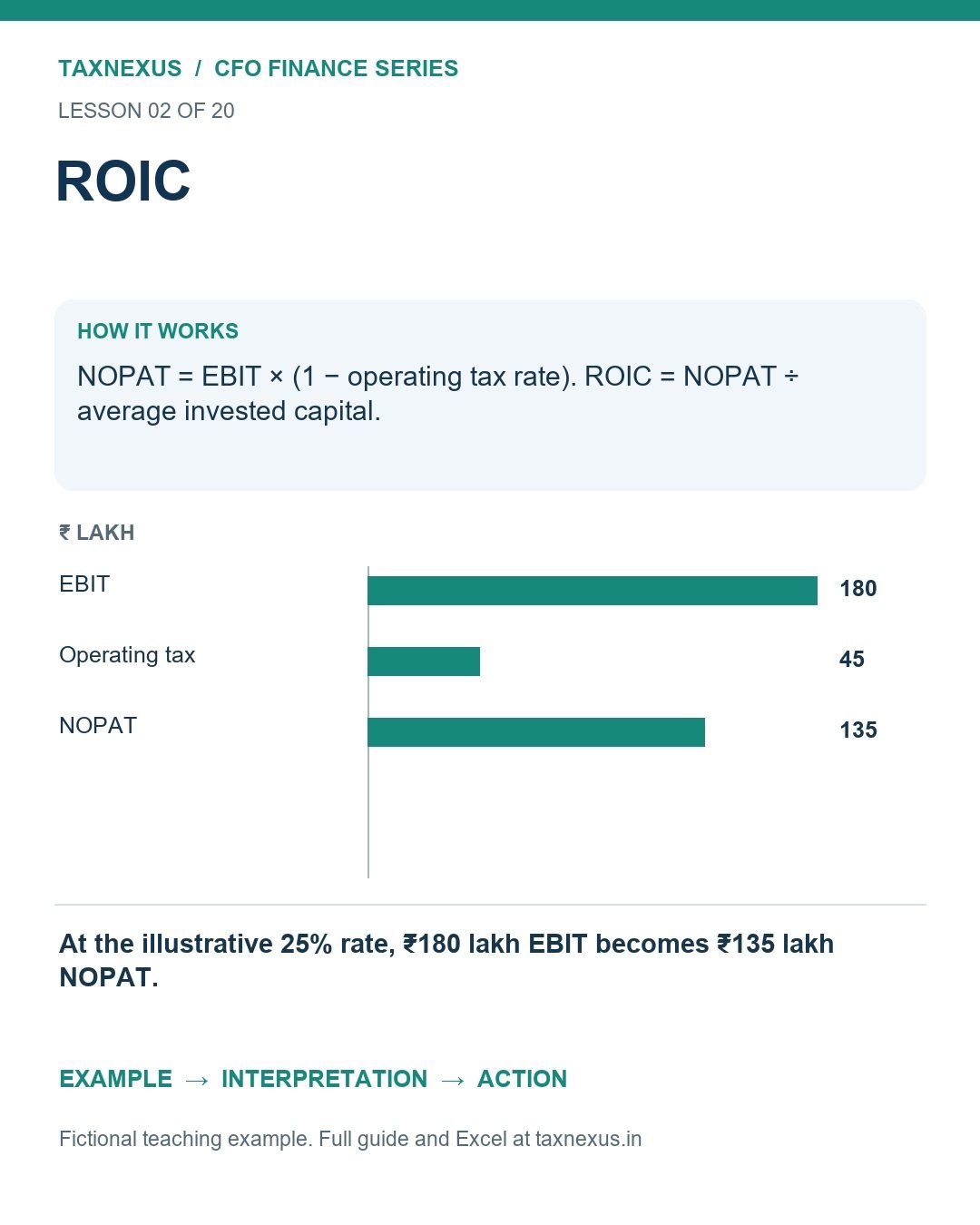
NOPAT = EBIT × (1 − operating tax rate). ROIC = NOPAT ÷ average invested capital.
Worked hotel example
The following records and amounts are fictional teaching data.
| Item or assumption | Example |
|---|---|
| Annual EBIT | ₹180 lakh |
| Illustrative operating tax rate | 25% |
| NOPAT | ₹135 lakh |
| Average invested capital | ₹900 lakh |
| ROIC | 15.0% |
| Illustrative comparable WACC | 11.0% |
What the result means for management
The fictional hotel earns ₹15 of annual after-tax operating profit per ₹100 of operating capital. A comparable 11% cost of capital gives a four percentage point spread. Applied to ₹900 lakh, that spread corresponds to ₹36 lakh of annual economic profit on this simplified average-capital basis. A new wing should be assessed using its incremental cash flows as well as the existing hotel’s ROIC.
ROIC calculator
Illustrative inputs are prefilled. Replace every field with amounts on the same reporting basis. Results are estimates using this guide’s method.
How to use ROIC in a finance review
- Reconcile operating profit to the management accounts and document unusual items.
- Build invested capital from the balance sheet. Identify surplus cash, operating payables and financing items explicitly.
- Use an average capital balance that reflects the timing of additions. Apply the same lease and goodwill policy across periods.
- Compare with an appropriate after-tax cost of capital, then investigate low-return assets and the practical cash consequences of proposed changes.
Assumptions and limitations
The 25% tax rate is a teaching assumption, not a statement of an applicable Indian tax rate. Tax losses, lease treatment and acquisition accounting can change the analysis. Historical book-capital returns do not establish a project’s future return.
How is ROIC different from ROE?
ROIC focuses on operating returns to all capital providers. ROE uses net profit after financing costs relative to equity. Their numerators and denominators serve different purposes.
Prepared by the TaxNexus Editorial Team. Examples and tools are educational estimates. Check the inputs, accounting basis and assumptions against your organisation’s records and approval policies before making a decision.