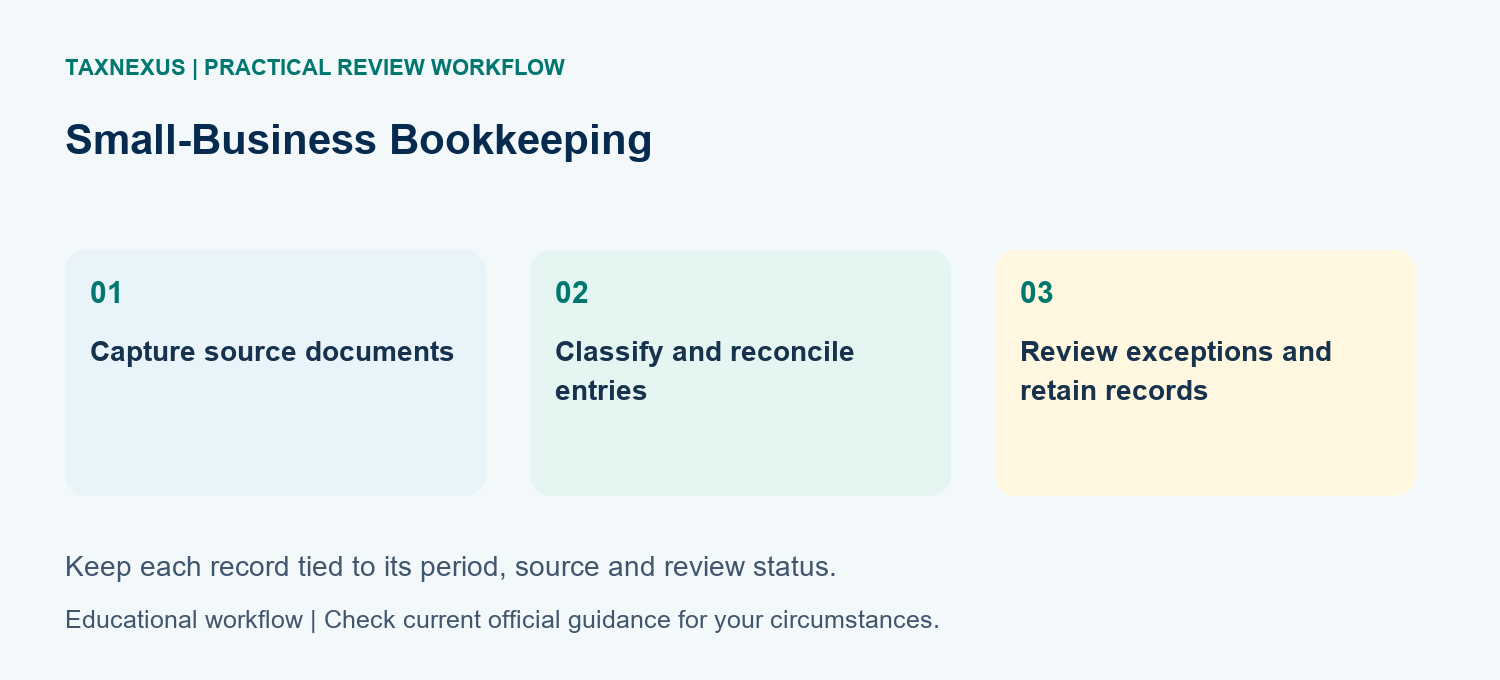
US Small Business Bookkeeping & Recordkeeping
Build a clean, repeatable recordkeeping system that supports decisions and federal tax preparation.
Quick answer
A reliable bookkeeping system records every business transaction, separates business and personal activity, preserves supporting documents and makes income and expenses easy to reconcile.
Set up the foundation
- Use a dedicated business bank account and payment methods.
- Choose accounting categories that match the way the business operates.
- Record sales, fees, refunds, purchases and owner transactions consistently.
- Reconcile bank and card accounts every month.
- Back up digital records and protect access.
Documents to organise
- Sales invoices, receipts and payment-processor reports.
- Supplier bills and proof of payment.
- Payroll, contractor and employment-tax records.
- Asset purchases, loan statements and financing documents.
- Mileage, travel and other substantiation where relevant.
Month-end checklist
Reconcile cash accounts, review outstanding invoices and bills, check unusual balances, post payroll and depreciation entries, and compare results with prior periods. Investigate differences before closing the month.
Small business bookkeeping: a system with a clear trail
Choose a system that connects each business transaction to its evidence. A useful register includes the date, customer or vendor, description, category, gross amount, fees, payment account and document reference. Maintain a separate list of open questions so uncertain classifications are reviewed rather than buried in a miscellaneous account.
- Collect sales invoices, receipts, payment-processor reports, expense documents and bank statements in a consistent folder structure.
- Match bank activity to the books each month and investigate duplicated imports, missing deposits and timing differences.
- Reconcile sales channels to gross sales, refunds, processor fees and net deposits. Net cash received is not always the same as revenue.
- Track owner contributions and withdrawals separately from operating receipts and expenses.
- Prepare a monthly profit-and-loss review and a balance-sheet review. Investigate unexpected negative balances and old unreconciled items.
Example: payment-processor settlement
A customer pays $1,000 and the processor retains a $30 fee before depositing $970. Recording only a $970 sale can hide the fee and make sales reconciliation difficult. A clearer working paper explains the $1,000 gross receipt, $30 fee and $970 deposit, subject to the accounting method and treatment appropriate to the business. This is a bookkeeping illustration, not a determination of deductible tax expense.
What to hand to your preparer
Provide reconciled reports, bank and processor statements, supporting documents, asset purchases and a list of uncertain items. Explain the accounting method used and any changes during the year. Do not assume a receipt guarantees deductibility: business purpose, limitations and tax rules still matter. Protect customer and employee information and keep secure backups of records. For a sole proprietor’s wider tax workflow, read the self-employment guide. Entity choice can change filing requirements, so do not treat Schedule C as the default for every business.
Small business bookkeeping handover checks
Use a short exception list when someone else reviews the books. For each unresolved transaction, record the amount, date, source document and question. Distinguish a missing receipt from a timing difference or an uncertain category; those problems require different follow-up. Mark the answer and reviewer once it is resolved.
Before sharing a report, state the period and whether the accounts have been reconciled. A draft balance should not be presented as a completed close. Keep the version sent to the preparer with the underlying working papers so later corrections can be traced. This is especially useful when a bank feed imports transactions after the initial review.