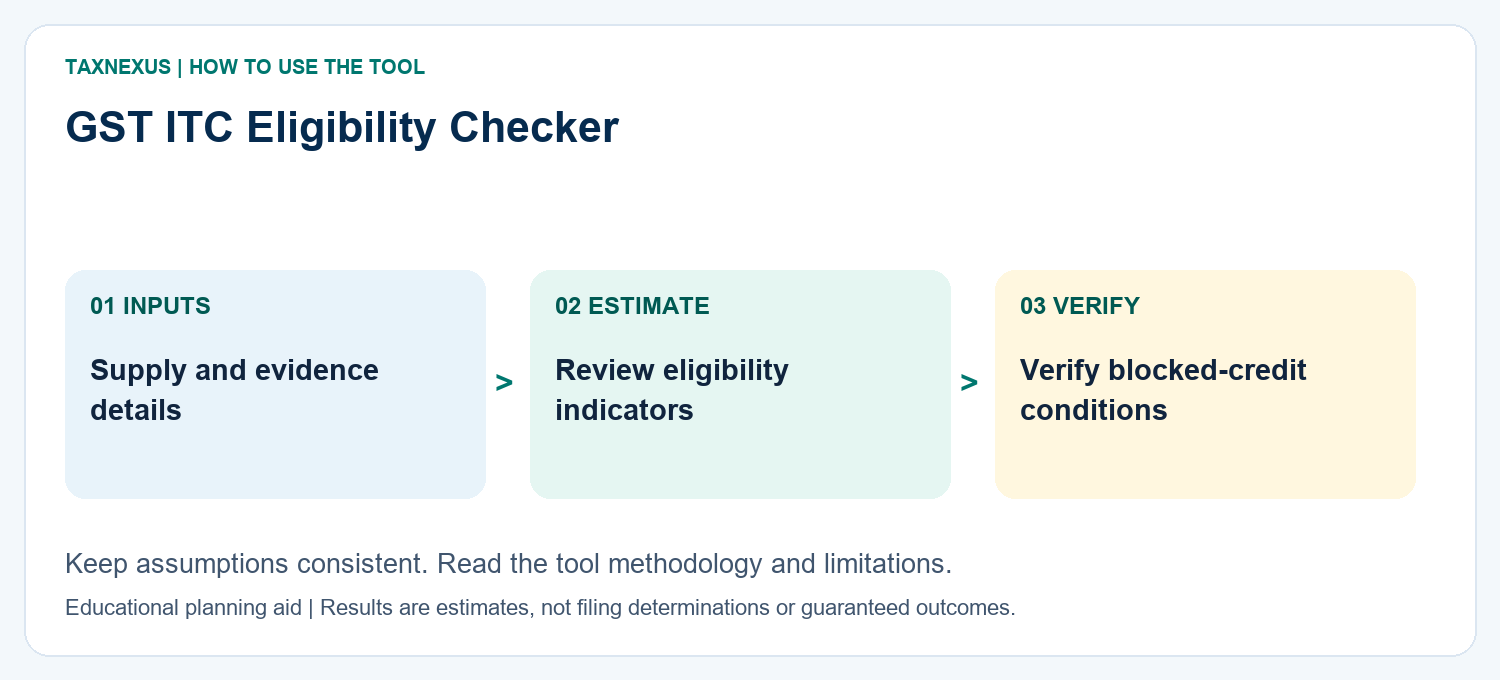
Use the GST ITC Eligibility Checker to organise invoice-screening questions, not to authorise a credit claim. The result depends on the facts entered and does not verify supporting documents or connect to the GST Portal.
GST ITC Eligibility Checker
Invoice screening, 15 purchase categories and batch Excel reports.
Educational screening tool. Review the result and supporting evidence before making a filing decision. GSTR-2B presence is necessary for covered supplier invoices, but does not establish eligibility. No connection to the GST portal. Verify applicable law before claiming credit.
Single invoice screening
Batch Excel upload
Use the template rather than an unmodified GST-portal export. First sheet only; .xlsx, .xls or CSV, up to 5 MB / 5,000 rows. Category suggestions never confirm tax eligibility. No vendor-name guessing.
Category codes and instructions
ordinary: Ordinary taxable-business purchase
vehicle: Passenger motor vehicle (up to 13 seats)
vessel: Vessel / aircraft
repair: Vehicle / vessel / aircraft insurance or servicing
food: Food, beverages or outdoor catering
beauty: Beauty / health / cosmetic services
rent: Leasing / renting covered vehicles
insurance: Life / health insurance
club: Club / health / fitness membership
travel: Employee vacation travel benefits
works: Works contract for immovable property
construction: Own-account immovable-property construction
personal: Personal consumption
gift: Lost / stolen / destroyed / written-off goods or gifts / free samples
special: Composition / non-resident / CSR / demand-related tax
Columns: Invoice, GSTIN, Category, Tax, GSTR2B, Conditions. GSTR2B and Conditions accept yes, no, unknown; GSTR2B also accepts na. Missing/invalid facts are flagged, never treated as eligible.
Read the result correctly
“Potentially eligible” applies only to the ordinary category after confirmed checks; it is not an entitlement. Conditional categories need documentary review of statutory exceptions. Rule 37 supplier-payment checks, Rule 37A, Section 16 time limits, tax payment, invoice/receipt evidence, restrictions and reversals must be checked separately. Imports, RCM and ISD require their own documents and conditions.
Reference: CBIC current legislation · ITC reversal guide · GSTR-2B reconciliation · Rules 42 & 43 tool
GST ITC Eligibility Checker: 3 essential review checks
- Confirm the purchase category. Classify the actual supply and its use, rather than choosing an ordinary category because it produces a favourable result. Keep the invoice, agreement and business-purpose evidence available for review.
- Record statement evidence separately. GSTR-2B matching and legal eligibility are different checks. A matching invoice does not resolve every restriction or establish that all conditions have been met.
- Keep unknown facts visible. If a condition has not been checked, retain that status and assign follow-up. An unresolved fact should not be converted to yes simply to finish a batch report.
Review a batch result before sharing it
Use the required template and test a small anonymised sample first. Check that columns, category codes and tax amounts were read correctly. Keep the source file unchanged and make corrections in a separate working copy with an explanation.
For each exception, record the document reference, question, responsible reviewer and outcome. The report should distinguish a missing fact from a known restriction and from a question needing specialist review.
Keep the claim decision separate
The GST ITC Eligibility Checker supports a screening workflow. Final credit treatment requires the applicable conditions, evidence, period and return reporting to be reviewed. Retain that reasoning alongside the report rather than treating a label as a tax opinion.