CFO Finance Series · Lesson 1 of 20
DuPont analysis explains what drives return on equity (ROE). It separates the return into net profit margin, asset turnover and the equity multiplier, so a finance team can investigate how operating performance and financing affect shareholders’ returns.
Download CFO Analysis Excel Toolkit (.xlsx)
Use the Returns worksheet for this lesson. Yellow cells are editable inputs. Reproduce the guide’s example using its stated inputs, as other toolkit examples may use different assumptions.
DuPont Analysis explained
Use profit and revenue for the same full period. Average assets and average equity should cover that period too. The three factors cancel algebraically to net profit divided by average equity. This is the three-factor version of DuPont analysis. A five-factor version also separates the interest and tax effects.
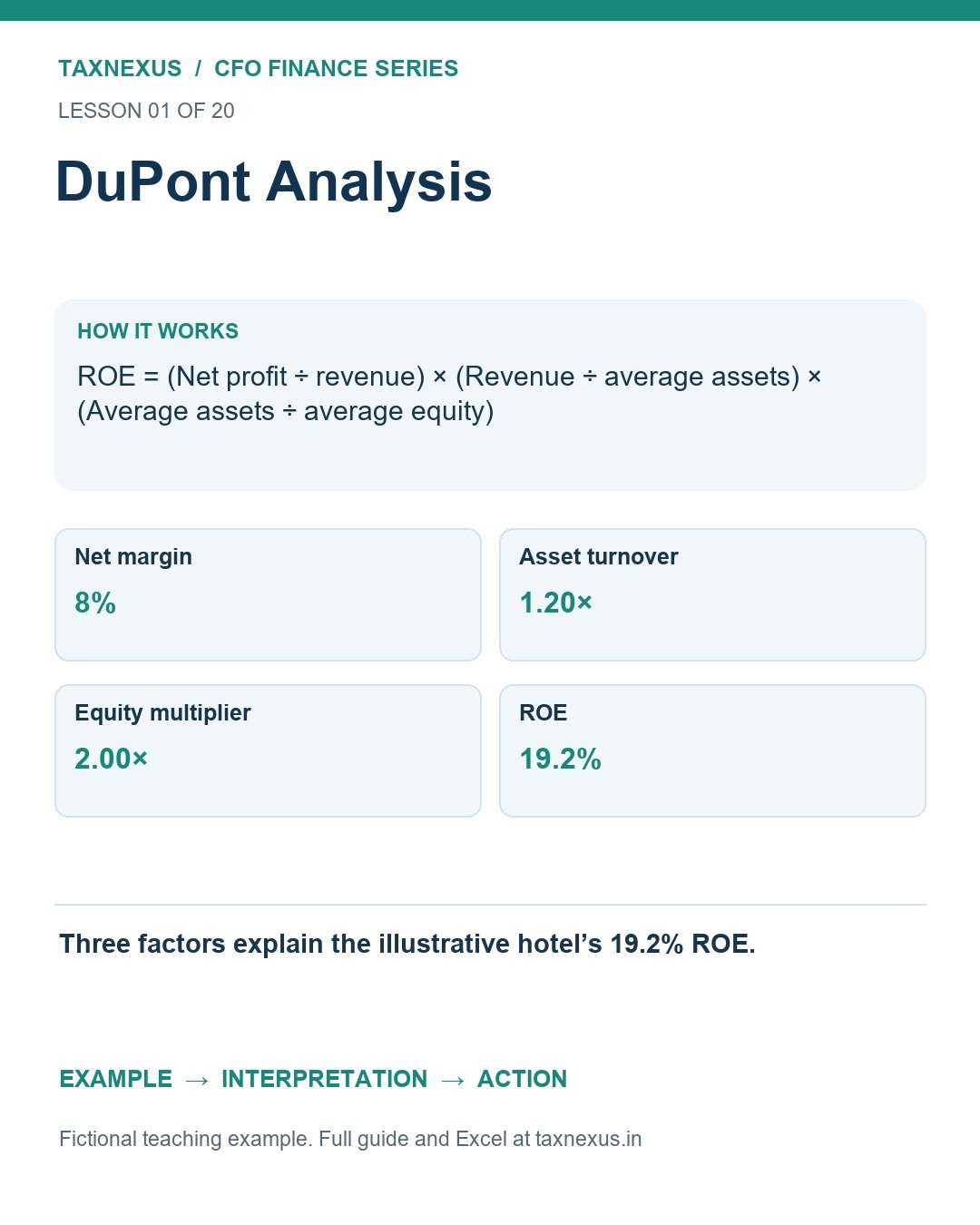
ROE = (Net profit ÷ revenue) × (Revenue ÷ average assets) × (Average assets ÷ average equity)
Worked hotel example
The following records and amounts are fictional teaching data.
| Item or assumption | Example |
|---|---|
| Revenue | ₹1,200 lakh |
| Net profit | ₹96 lakh |
| Average assets | ₹1,000 lakh |
| Average equity | ₹500 lakh |
| Margin × turnover × multiplier | 8% × 1.20 × 2.00 |
| Return on equity | 19.2% |
What the result means for management
In this fictional hotel, each ₹100 of sales produces ₹8 of net profit. Each ₹1 of average assets supports ₹1.20 of revenue. Assets are twice average equity. Together, these generate 19.2% ROE. If the equity multiplier rises to 2.5 while the other factors stay constant, the arithmetic ROE becomes 24%. That is a financing effect. In practice, extra borrowing may also raise interest costs and reduce the margin.
DuPont Analysis calculator
Illustrative inputs are prefilled. Replace every field with amounts on the same reporting basis. Results are estimates using this guide’s method.
How to use DuPont Analysis in a finance review
- Tie profit and revenue to the closed income statement. Remove inconsistent treatment of discontinued or exceptional items before comparison.
- Calculate average opening and closing balances. Use monthly averages when large additions or capital injections make a two-point average misleading.
- Investigate margin through room, food and beverage, payroll and overhead schedules. Investigate turnover through capacity and asset utilisation.
- Review debt, interest cover and cash forecasts before treating a higher equity multiplier as an improvement. Assign an owner to each operational action.
Assumptions and limitations
ROE can become difficult to interpret when equity is negative or very small. Asset revaluations, leases and different accounting policies also affect comparisons. There is no universal good ROE for every hotel.
Can two hotels have the same ROE for different reasons?
Yes. One may earn a stronger margin with modest borrowing, while another relies on a higher equity multiplier. Compare the components and financing risk, then review cash generation.
Prepared by the TaxNexus Editorial Team. Examples and tools are educational estimates. Check the inputs, accounting basis and assumptions against your organisation’s records and approval policies before making a decision.