PAYE and National Insurance Estimator
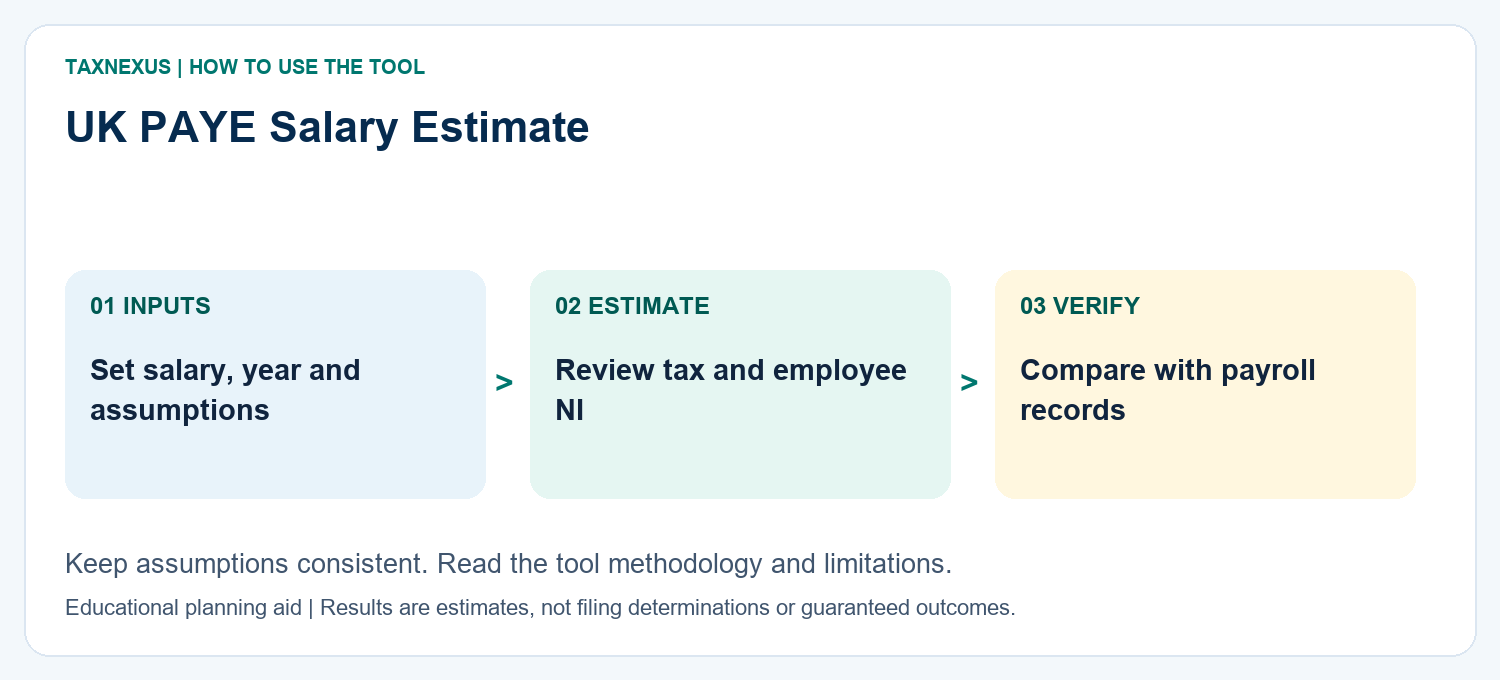
Estimate 2026/27 Income Tax, employee National Insurance and take-home pay for England, Wales and Northern Ireland. This illustration does not reproduce an individual tax code or payroll run.
How the estimate works
For 2026/27, the standard Personal Allowance is £12,570. It reduces by £1 for every £2 of adjusted net income above £100,000 and is nil at £125,140. For England, Wales and Northern Ireland, this calculator applies the 20% basic, 40% higher and 45% additional rates using the standard bands. It then estimates employee Class 1 National Insurance at 8% between £12,570 and £50,270 and 2% above £50,270.
Useful checks before relying on the number
- Compare the tax code on your payslip with your HMRC account.
- Include taxable benefits and other income when checking your overall liability.
- For a company director, remember that National Insurance can use an annual earnings period.
- Use actual payroll software for payslips and Real Time Information submissions.
Running your own company? Read our UK Director Salary and Dividends Guide before choosing how to withdraw funds.
Last reviewed: 20 October 2026. Official references: GOV.UK Income Tax rates, Income Tax rates and allowances, and Employer rates and thresholds 2026/27.
National Insurance and tax: 4 essential input checks
- Use annual gross employment pay. Keep the annual figure separate from monthly net pay, employer cost and other household income. Entering a bank-credit total as gross salary understates the starting amount.
- Check the salary-sacrifice assumption. This field models the arrangement described by the tool. Other pension methods can affect payroll differently, so do not subtract every pension contribution here without checking its treatment.
- Confirm the region and period. Read the supported tax-year and regional limits. Selecting an unsupported region is a warning to use the correct calculation elsewhere, not a way to obtain a complete local result.
- Review excluded adjustments. Individual tax codes, loans, benefits, multiple employments and other facts can change actual deductions. Keep a separate list of items the model does not calculate.
Why actual monthly payroll can differ
An annual estimate divided into months is a planning comparison. Actual payroll can reflect the tax code, timing of earnings, year-to-date information and other adjustments. National Insurance and Income Tax also need to be reviewed on their own applicable bases rather than as one combined percentage.
Compare the estimator’s assumptions with the payslip before concluding that a payroll result is wrong. A difference may require a question about the input, period or excluded adjustment rather than a change to the employer’s calculation.
Retain a scenario record
Save the gross annual amount, selected period, salary-sacrifice assumption and exclusions with the result. Change one input at a time when comparing scenarios. Continue with the UK PAYE guide for a practical payslip-review workflow and use the official references above for current requirements.