UK Income Tax & PAYE Guide
Understand how Income Tax is commonly collected through PAYE and when additional reporting may be needed.
Quick answer
PAYE normally deducts Income Tax and National Insurance from employment or pension income. Your tax code helps determine deductions, but other income or circumstances can create a Self Assessment obligation or require HMRC to adjust the code.
Check your tax position
- Review the tax code shown on payslips and HMRC records.
- Check that employers and pensions are using the expected code.
- Keep P45, P60, payslips and benefit information.
- Report relevant changes and untaxed income when required.
What PAYE does
Employers and pension providers apply HMRC tax codes when calculating deductions. A code is not a complete tax return; it is a mechanism for collecting tax during the year. Multiple income sources can require additional attention.
When Self Assessment may apply
Self Assessment can apply to self-employment, partnership income, certain untaxed income and other circumstances defined by HMRC. Use the current HMRC checker rather than assumptions based only on income level.
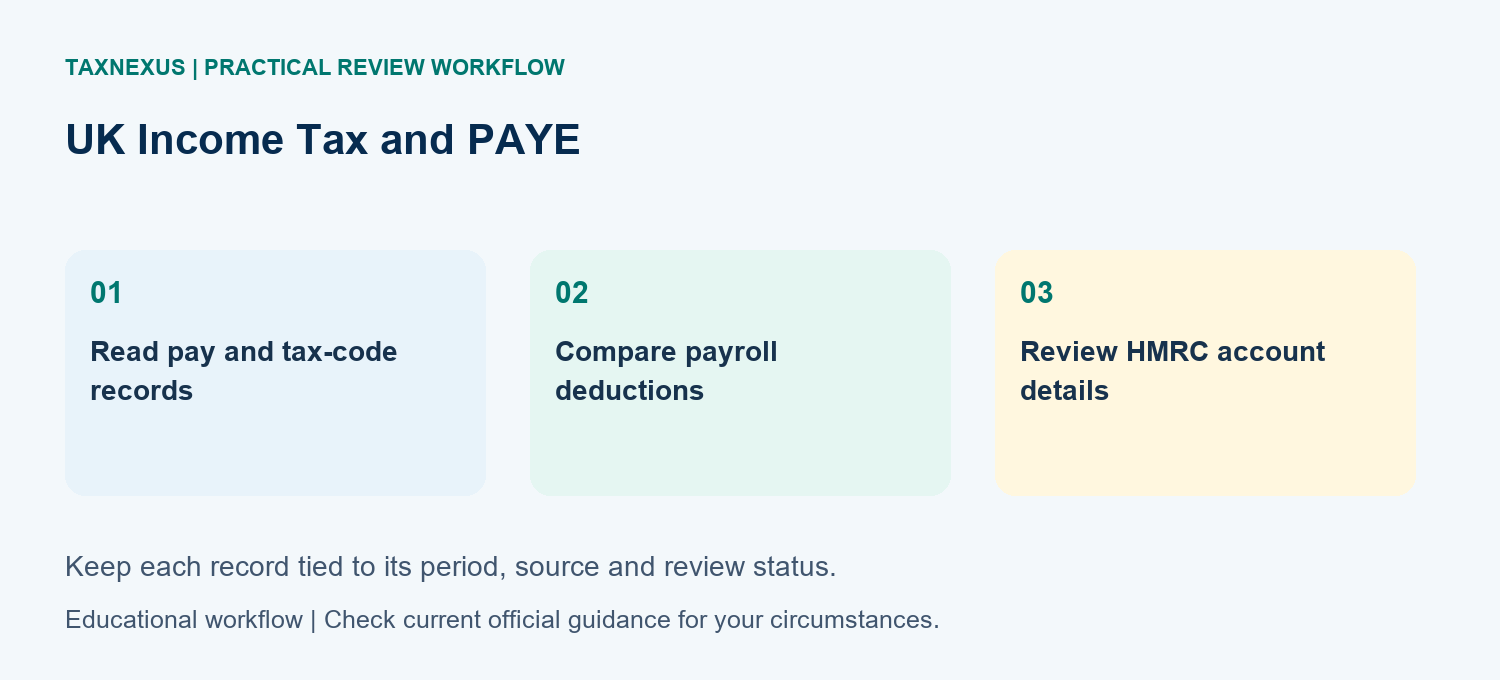
PAYE: read your payslip as a reconciliation
Begin with the pay period and tax year. Compare contractual pay with gross pay, then identify taxable benefits or adjustments and each deduction. Net pay should reconcile to the amount received in your bank account. Pension deductions and other payroll items may use different calculation bases, so a single percentage of gross pay will not explain every line.
- Check the employer and pay-period details, especially after changing jobs.
- Compare your tax code with HMRC’s explanation and the code shown in your personal tax account.
- Review year-to-date taxable pay and Income Tax, not only the current month’s deduction.
- Check whether the code or basis changed and whether a one-off bonus, benefit or payroll correction explains an unusual result.
- Raise pay or payroll-record errors with the employer; use HMRC’s service when the tax-code information held by HMRC needs correction.
Example: a deduction changes after a new job
A worker changes employers and sees a larger Income Tax deduction on the first payslip. Before concluding that the tax rate increased, they compare the code, pay frequency, taxable pay and year-to-date information with the earlier employment documents. This creates a focused enquiry for payroll or HMRC. It does not establish an entitlement to a refund by itself.
Records to keep
Keep payslips, relevant employer benefit information and the documents issued when employment ends or the tax year closes. Record when you notified HMRC of a change and retain the response. With multiple jobs or pensions, review the combined position instead of checking each income source in isolation. PAYE deductions do not automatically remove a separate Self Assessment obligation. Use the Self Assessment guide to prepare that review, and the PAYE and National Insurance estimator only as an illustration of the assumptions displayed by the tool.
PAYE enquiry checklist
Write down which payslip line changed and the date from which it changed. Compare the amount with an earlier period on the same basis. If the pay period was shorter, a bonus was included or a correction was posted, describe that difference when asking payroll to investigate.
Keep a note of the question, who you contacted and the response. Recheck the following relevant payslip after a correction is confirmed. This gives you a clear record of what was resolved and avoids treating an expected future correction as though it has already appeared in net pay.