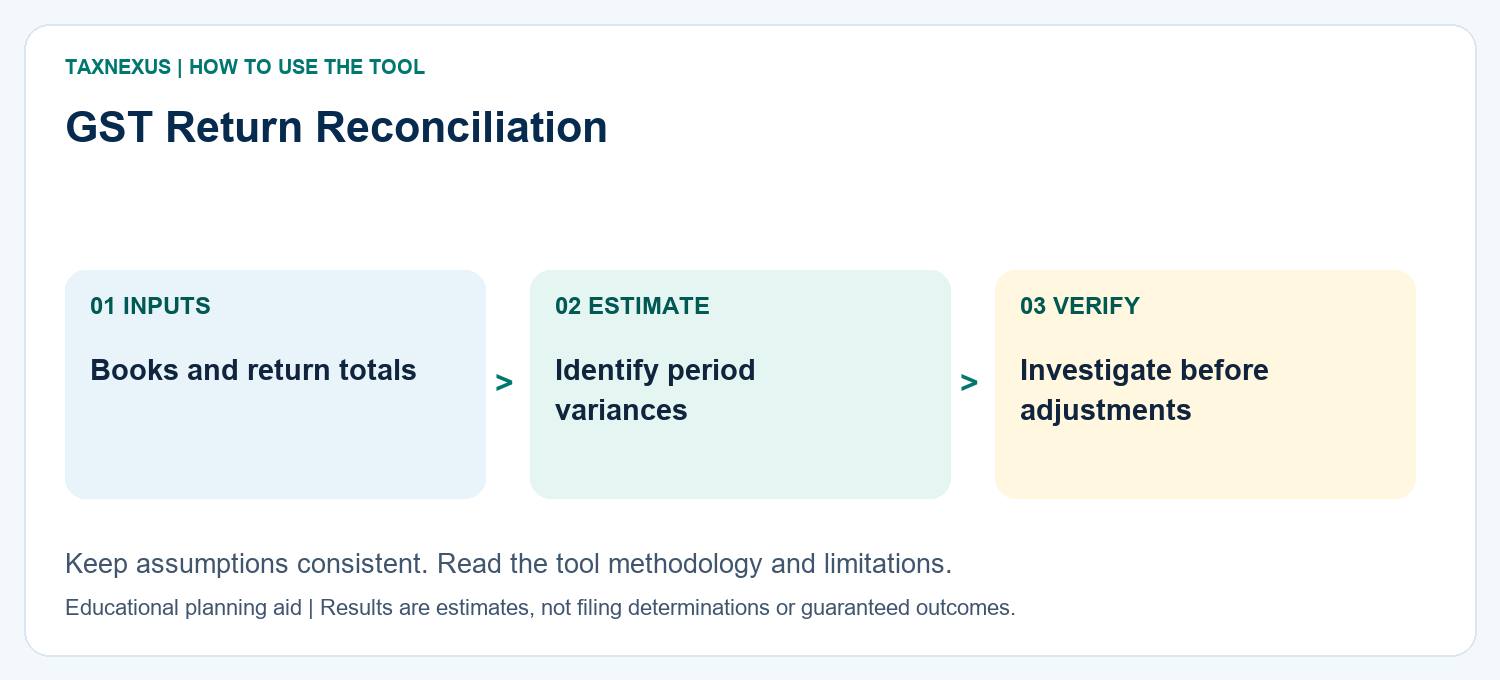
GSTR-3B vs GSTR-1 comparison works best when both summaries are also reconciled to the books. Prepare three comparable CSV files, review the period mapping and use the result to investigate differences.
GSTR-3B vs GSTR-1 vs Books Reconciliation
Compare period totals from three CSV files locally in your browser.
CSV columns: period,taxable_value,igst,cgst,sgst. Your files stay in this browser.
Prepare comparable period totals
This tool compares three CSV summaries rather than logging in to the GST Portal. Use columns period,taxable_value,igst,cgst,sgst for the books, GSTR-1 and GSTR-3B files. Use the same period labels in every file and document what each total includes. Keep original exports and a record of the steps used to prepare the summaries.
- Choose the same entity, registration and reporting period for all three sources.
- Identify the outward-supply and tax figures being compared. Do not mix unrelated return tables merely because they contain similar totals.
- Check treatment of credit notes, debit notes, amendments, exports and adjustments before importing the files.
- Use plain numeric values and consistent signs. Download the template to confirm the expected structure.
- Set a small, documented rounding tolerance and review every material variance.
Worked example: a difference is not automatically unpaid tax
Assume the books and GSTR-1 each show taxable value ₹1,00,000 and IGST ₹18,000, while the comparable GSTR-3B summary shows IGST ₹17,000. The ₹1,000 difference is an investigation point. First check whether the summaries cover the same scope, whether an amendment belongs to another period and whether the figure was entered correctly. The tool does not determine the filing correction, interest or payment required.
Resolve differences in a controlled order
Start with missing or duplicate periods. Then check taxable values and each tax component separately. Reconcile document-level details where a summary difference persists. Record a reason for each adjustment and link it to a source document or portal record. Re-run the comparison only after preparing a corrected working copy; retain the original version for the audit trail.
What a clean comparison cannot prove
Equal totals can conceal offsetting invoice errors. The comparison does not test the legal classification of a supply, place of supply, invoice compliance or whether every transaction was reported. It is a period-summary control, not a full GST audit. A tolerance is a matching setting and does not create a statutory exemption from correcting an error.
Records and privacy
Processing is designed to take place in your browser. The tool does not submit files or amendments to government systems. Keep the three source exports, mapping notes, exception list and approved resolution together. Use anonymised data when demonstrating the tool and do not share confidential client or employer documents through the contact form.
Read the GSTR-1 vs GSTR-3B reconciliation checklist and confirm filing actions through the official GST Portal. Results support investigation and do not replace professional judgement.
GSTR-3B vs GSTR-1: 3 essential review checks
- Check scope before matching. Confirm the source tables and tax heads included in each file. Similar column names do not prove that the underlying population is comparable.
- Keep the original files. Make corrections in a separate working copy and record the reason. This allows another reviewer to reproduce how the final comparison was prepared.
- Review the exception outcome. Mark whether the difference was corrected, explained or remains open. A tolerance setting should not be used to conceal a known material problem.
Save the GSTR-3B vs GSTR-1 result with the books summary and review notes. The output identifies variances; it does not decide the appropriate statutory correction.