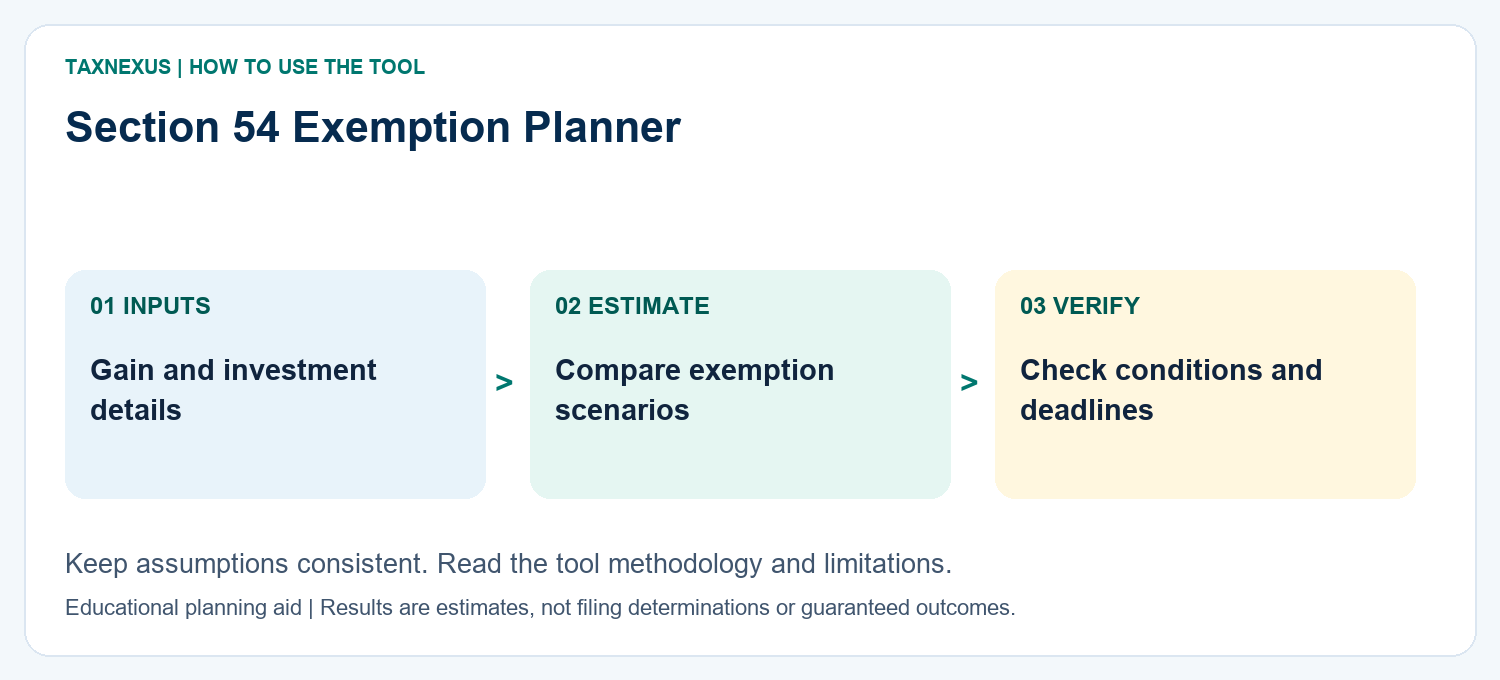
Section 54 planning requires more than comparing investment amounts. Use this preliminary tool to organise assumptions for the familiar 54, 54F and 54EC routes, then confirm the applicable legal framework and conditions.
Section 54 / 54F / 54EC Exemption Planner
Compare common reinvestment routes and estimate the maximum indicative exemption.
What the planner is for
This is a preliminary comparison of reinvestment routes commonly referred to as Sections 54, 54F and 54EC under the Income-tax Act, 1961. It helps organise a discussion about an eligible long-term gain and proposed investments. It does not establish eligibility or reserve an exemption.
Prepare the figures and documents
Start with a separate capital-gains working paper. Gather the original asset details, transfer date, sale documents, qualifying expenses, computed gain, ownership information and evidence of the proposed reinvestment. Net consideration and capital gain are different amounts; entering the gain in both fields can produce a misleading comparison.
Illustrative proportional calculation
Suppose a hypothetical case uses a gain of ₹10 lakh, net consideration of ₹40 lakh and a qualifying reinvestment of ₹20 lakh. A simple proportion is ₹10 lakh × ₹20 lakh ÷ ₹40 lakh = ₹5 lakh. This example illustrates proportional arithmetic only. It does not establish that the asset, taxpayer, house or timing meets the legal requirements.
Review conditions outside the formula
Check the original asset, taxpayer category, ownership tests, purchase or construction dates, deposit requirements, applicable caps and later disposal restrictions. The tool cannot verify title documents, count all properties you own, determine compliance with deposit rules or inspect bond eligibility. Review each route independently rather than adding every displayed amount together.
Check the tax period before relying on section labels
The Income-tax Act, 2025 applies from 1 April 2026 and uses a different legal framework. This planner retains familiar 1961 Act section labels. Confirm the provisions and transition treatment applicable to your transfer and filing period. Do not assume a familiar section number or a calculator result proves that the same rule applies to a later transaction.
Keep an evidence trail
Save the input assumptions and supporting documents, document why a route is considered eligible and obtain an appropriately qualified review before committing funds or filing a return. A calculation summary is not an approval from the tax department.
Consult the Income Tax Department and its Income-tax Act, 2025 guidance. Use the capital-gains tool only as a separate indicative working aid.
Section 54 planning: 4 essential evidence checks
- Separate the starting figures. Keep the gain computation and net-consideration working together, with a clear explanation of any difference.
- Record the chosen route. Note why the original asset and proposed reinvestment are being considered under that route. A field label does not verify eligibility.
- Build a date schedule. Record the transfer, proposed investment and supporting-document dates. Check the applicable deadlines independently of the formula result.
- Obtain a final review. Ask the reviewer to address ownership, caps, timing and later restrictions, including questions the calculator cannot test.
Keep the Section 54 comparison separate from any final filing instruction. Record which assumptions remain provisional so an indicative amount is not mistaken for confirmed relief.