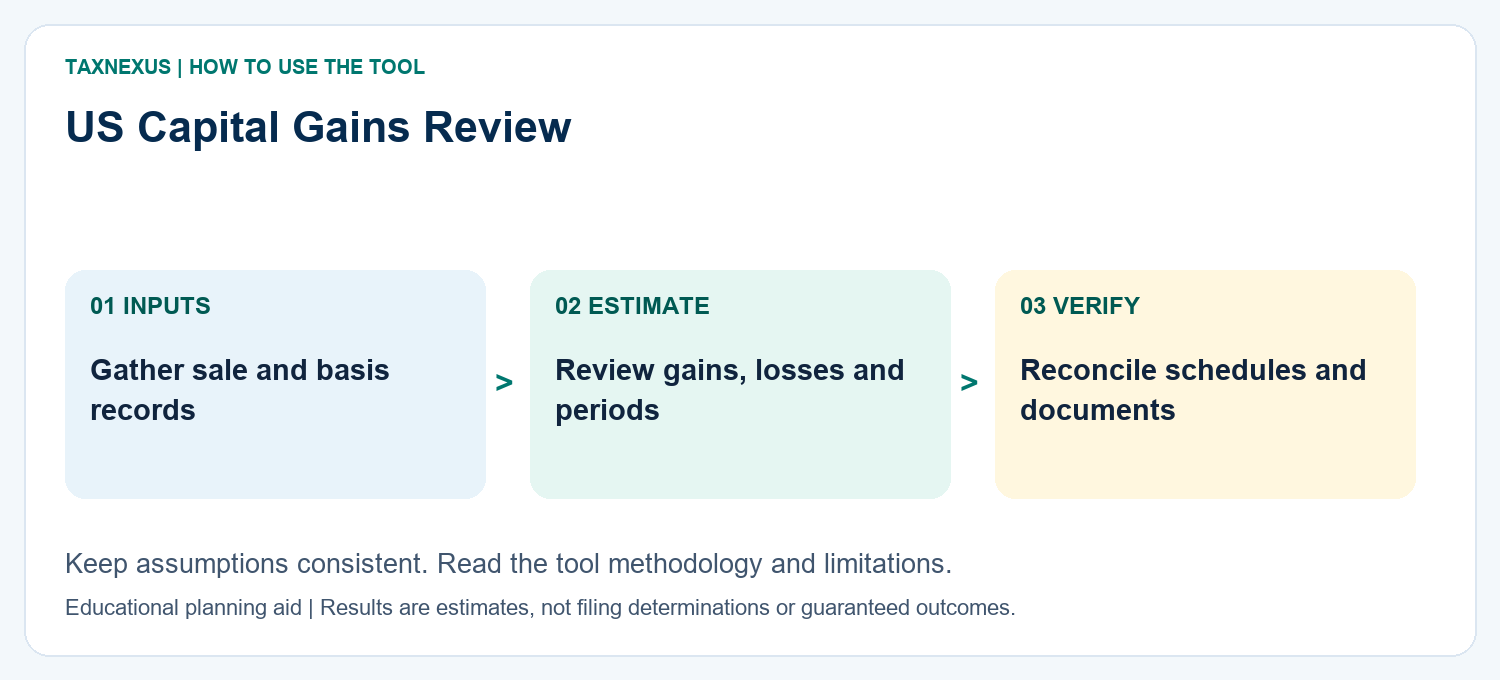
US capital gains review starts with sale records, adjusted basis and the holding period. Use the six-check preparation list below and confirm the final reporting treatment for the asset and taxpayer.
Capital gains, without the jargon
Understand cost basis, holding periods, losses, home-sale rules and the records you need before you sell an investment.
A capital gain is usually the difference between what you receive when you sell a capital asset and your adjusted basis in that asset. Shares, mutual funds, real estate and many personal-use assets can fall within the rules. The headline tax rate matters, but accurate basis and the character of the gain matter first.
Start with three numbers
| Number | What to include |
|---|---|
| Amount realized | Sale proceeds, usually adjusted for selling costs. |
| Adjusted basis | Purchase cost plus or minus permitted adjustments such as commissions, improvements, reinvested distributions or depreciation. |
| Holding period | Generally, whether you held the asset for one year or less, or for more than one year. |
A sale held for one year or less usually produces a short-term gain or loss. A sale held for more than one year usually produces a long-term result. Short-term net gains are generally taxed at ordinary income-tax rates; long-term gains may qualify for preferential rates, depending on taxable income and the kind of asset.
Why your broker’s number may not tell the whole story
Broker statements and Form 1099-B are a strong starting point, but you are responsible for the return. Basis can need correction after transfers between brokers, inherited or gifted property, wash sales, stock splits, return of capital, employee stock awards or reinvested fund distributions. Keep original confirmations and annual statements even after changing platforms.
Losses can offset gains
Capital losses generally offset capital gains during the netting process. If losses exceed gains, individuals may be able to deduct a limited net capital loss against other income and carry the remaining loss forward, subject to the federal rules. The ordering between short-term and long-term categories matters.
Selling your main home
A qualifying sale of a main home may allow an exclusion of up to $250,000 of gain, or up to $500,000 for certain married couples filing jointly. Ownership and use tests, prior exclusions and special circumstances apply. Keep closing statements and records of capital improvements; routine repairs normally do not increase basis in the same way.
How the sale reaches your return
Many investment sales are reconciled on Form 8949 and summarized on Schedule D. Different reporting categories identify whether the IRS received basis information. Certain home sales, business property, collectibles, qualified small business stock and depreciation-related gains have special treatment.
US capital gains: a practical checklist
- Confirm the acquisition date and adjusted basis.
- Check unrealized gains and losses across all taxable accounts.
- Review the holding period before placing the trade.
- Estimate the effect on adjusted gross income, credits and Medicare-related thresholds.
- Keep enough cash for federal and state estimated payments if needed.
- Save the trade confirmation and update your tax records immediately.
Frequently asked questions
Do I owe tax when an investment rises in value?
Usually not merely because the market value increased. A taxable event commonly occurs when you sell, exchange or otherwise dispose of the asset, although special rules can apply.
Are capital-gains rates always 0%, 15% or 20%?
Those are familiar long-term federal rates, but not the entire picture. Short-term gains, collectibles, unrecaptured Section 1250 gain, Net Investment Income Tax and state tax can change the outcome.
What about cryptocurrency?
Digital-asset disposals can produce capital gains or losses when the asset is held for investment. Purchases, swaps and payments may all create records you need to reconcile. This guide is not a complete digital-asset tax guide.
Last reviewed: 20 October 2026. Official references: IRS Capital Gains and Losses FAQs, IRS Topic 409, and IRS Topic 701: Sale of Your Home.
For possible payment follow-up, read the US estimated-tax guide and keep the sale working with your federal return preparation records.