Stock market learning starts with understanding the asset, the business and the risks. Use this educational checklist to prepare better questions before reviewing a share or investment product.
Stock Market Basics: Understand Shares and Risk
This guide explains how to approach learning about shares before making an investment. TaxNexus provides education, not stock recommendations, trading signals or live market quotations.
What owning a share means
A share represents an ownership interest in a company. A share price can change as investors reassess the company, its business prospects and wider market conditions. A profitable company can still be an unsuitable investment at a particular price or for a particular investor. Dividends and price appreciation are possible outcomes, not promises.
Separate business performance from share-price movement
Start by understanding what the company sells, how it earns revenue and where its cash comes from. Read financial statements alongside the business narrative. Revenue growth, profit and cash flow describe different things: a company can record sales before receiving payment, while borrowing can temporarily increase its bank balance without improving operating performance.
For example, an illustrative business reports ₹10 lakh in revenue but collects only ₹7 lakh from customers during the period. The remaining amount requires an explanation through receivables and timing. This example is a financial-statement reading exercise, not a valuation or a recommendation to buy a security.
A checklist before investing
- Define the purpose of the money and when it will be needed.
- Consider how much loss you can financially bear, alongside your comfort with price changes.
- Understand the product, its charges and how readily it can be sold.
- Read company disclosures rather than relying only on social-media claims.
- Check the registration and identity of intermediaries through official channels.
- Keep investment records, contract notes and statements for reconciliation and tax reporting.
Recognise the risks
Share prices can fall because of market-wide events or company-specific problems. Liquidity can also be limited, making it difficult to sell at an expected price. Borrowing to invest adds repayment obligations even when an investment loses value. Diversification can reduce concentration, but cannot eliminate the possibility of loss.
Use calculators as scenarios
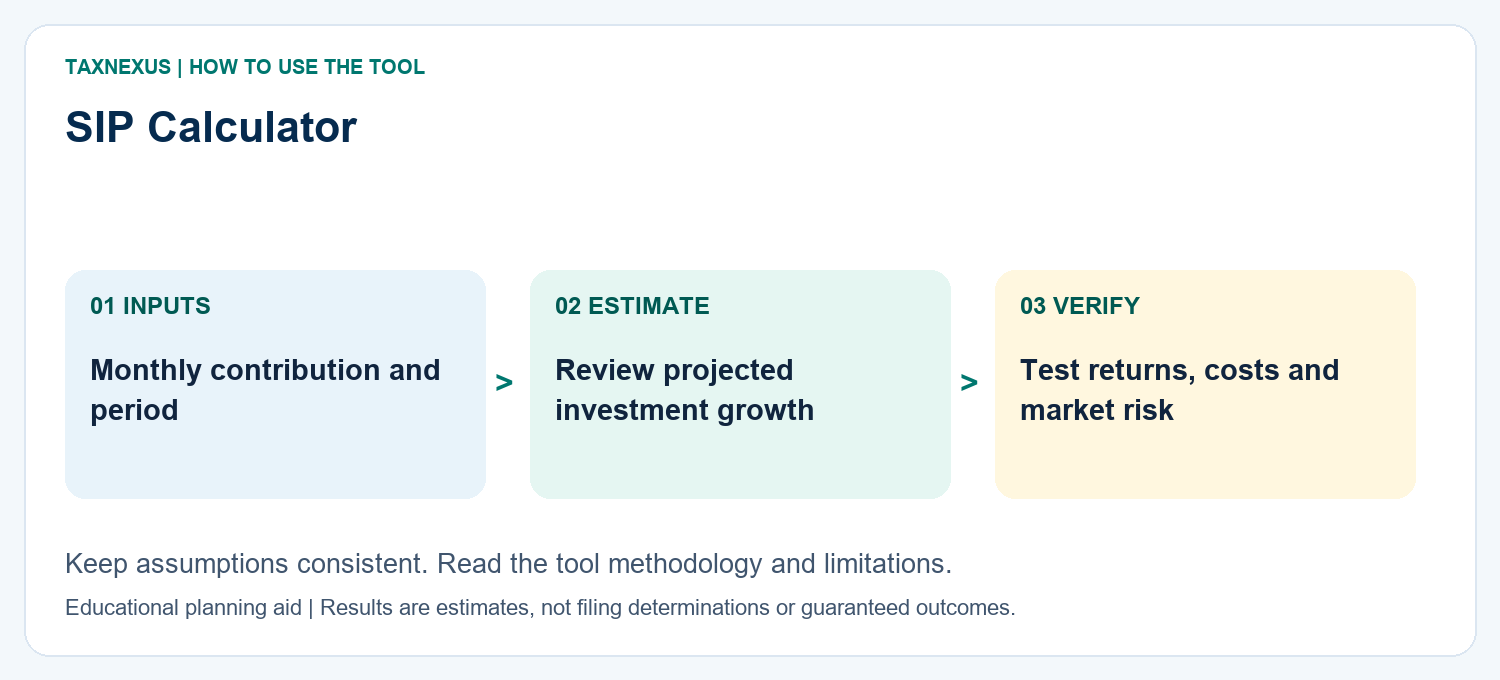
A SIP calculator or lumpsum calculator shows the mathematical result of an assumed return. It does not predict what a share or fund will earn. Compare several return assumptions and check how losses or a shorter holding period would affect your plan. A withdrawal illustration also depends on the sequence and timing of actual returns.
Official learning resources
Stock market research: keep facts and assumptions separate
Write down which figures came from company disclosures and which are your own assumptions. A forecast of growth is different from a reported result. Keep the date of the source because later information can change the picture.
For a simple illustration, revenue of ₹10 lakh and expenses of ₹8 lakh leave ₹2 lakh before other applicable items. That arithmetic does not tell you the value of the shares, the cash available for dividends or the price another buyer will pay. A financial statement contains several connected measures that should be reviewed together.
Record the question you are trying to answer
Distinguish a question about a business from a question about an investment price, liquidity or your own ability to bear loss. A useful research note identifies the uncertainty rather than treating every positive company announcement as a reason to invest.
Keep copies of the relevant disclosure and note the date reviewed. The stock market guide provides a learning framework, not a personalised recommendation or a complete valuation method.