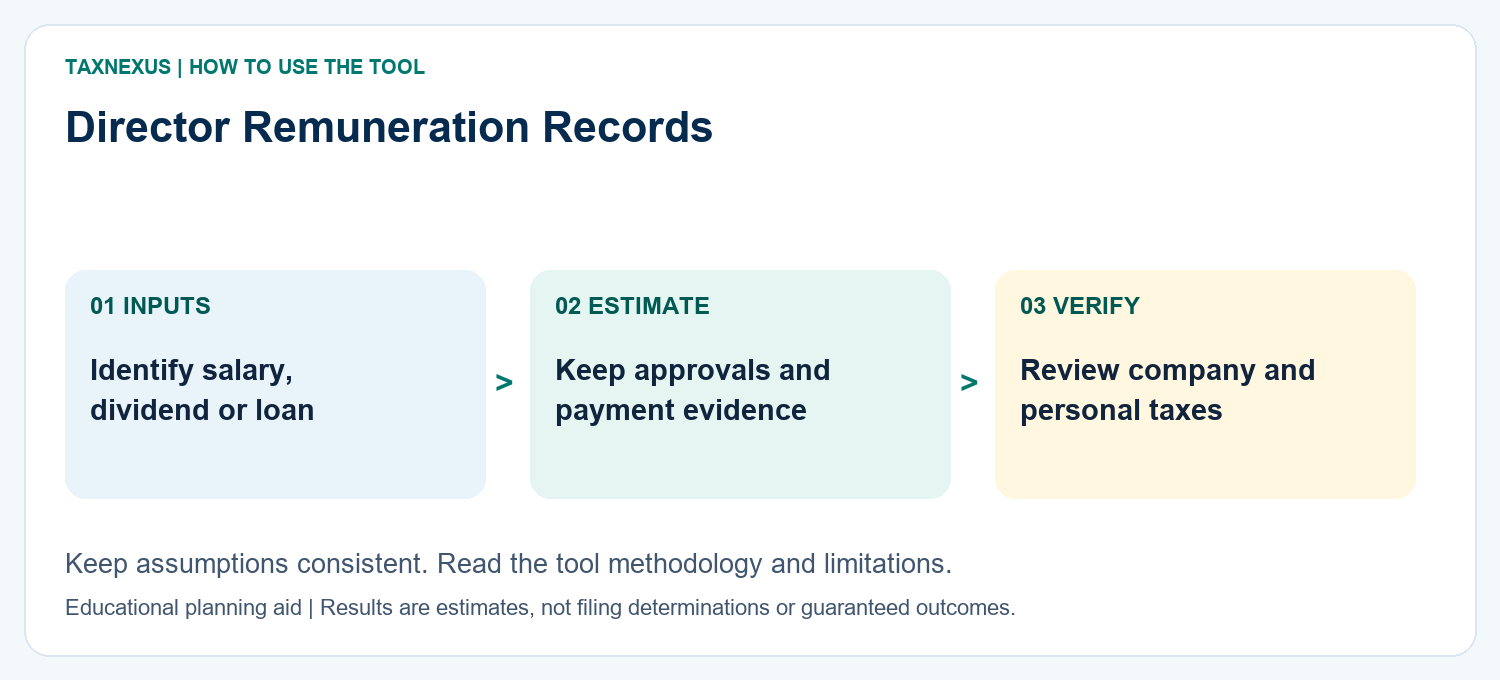
Director salary and dividends need a joint review of company records and personal tax circumstances. Use the six common-mistake checks below to frame a discussion, rather than copying a standard payment mix.
Director salary and dividends
A practical guide to taking money from a company, documenting dividends and avoiding the small mistakes that create large clean-up jobs.
There is no single salary-and-dividend mix that is right for every director. The company’s profit, available cash, other income, National Insurance position, pension plans and number of employees all affect the answer. Start with the legal route for each payment, then calculate the tax.
The main ways a director can take money
| Method | Key point |
|---|---|
| Salary or bonus | Runs through PAYE and can create employee and employer National Insurance. |
| Dividend | Can only be paid from available profits and requires proper company records. |
| Expense reimbursement | Should relate to genuine business costs and follow expense and benefit rules. |
| Director’s loan | Creates a balance between the director and company; tax consequences can arise if it remains overdrawn. |
| Employer pension contribution | Can be valuable but needs commercial, annual-allowance and corporation-tax review. |
Salary is not just a tax number
A director is an employee for National Insurance purposes. PAYE reporting, payslips and Real Time Information obligations can apply even in a one-person company. Directors normally have an annual earnings period for National Insurance, which means calculations can differ from an ordinary employee’s month-by-month pattern.
A salary can support qualifying years for state benefits and may be deductible for Corporation Tax when it is incurred wholly and exclusively for the business. Employer National Insurance and Employment Allowance eligibility can materially change the result, so avoid copying another director’s figure without checking your own facts.
Dividends need profit and paperwork
A dividend is not simply any transfer from the company bank account. The company must have sufficient distributable profits. Directors should review relevant accounts, approve the dividend and keep a dividend voucher for each shareholder. If the paperwork and profit are missing, the payment may need to be treated differently.
For 2026/27, the dividend allowance is £500. Dividend income above the allowance is generally taxed at 10.75%, 35.75% or 39.35%, depending on the taxpayer’s income band. The company does not deduct Income Tax when paying the dividend, but the shareholder may need to report and pay tax personally.
Common mistakes
- Calling a payment a dividend when the company has no distributable profit.
- Posting irregular withdrawals to dividends without minutes or vouchers.
- Ignoring an overdrawn director’s loan account until the year-end accounts.
- Using a salary figure from an earlier tax year after thresholds changed.
- Forgetting employer National Insurance or assuming Employment Allowance is automatic.
- Looking only at personal tax and not the company’s Corporation Tax and cash position.
Director salary and dividends: a better way to decide
Prepare a short forecast showing company profit before director pay, Corporation Tax, available reserves, salary cost, employer National Insurance and expected dividends. Then add the director’s other income and personal circumstances. Use our UK PAYE and National Insurance Estimator to sense-check employment deductions before discussing the full mix with an accountant.
Frequently asked questions
Can I pay a dividend every month?
A company can pay interim dividends during the year when it has sufficient distributable profits and the decision is properly made and recorded. A regular transfer is not automatically a lawful dividend.
Are dividends a company expense?
No. Dividends are distributions of profit after Corporation Tax, not a deductible business expense.
Can the company pay personal bills?
It can make the payment, but the accounting and tax treatment may be salary, a benefit, a dividend or a director’s loan depending on the facts. Record it correctly rather than leaving it in general expenses.
Last reviewed: 20 October 2026. Official references: Taking money out of a limited company, Tax on dividends, and National Insurance for company directors.