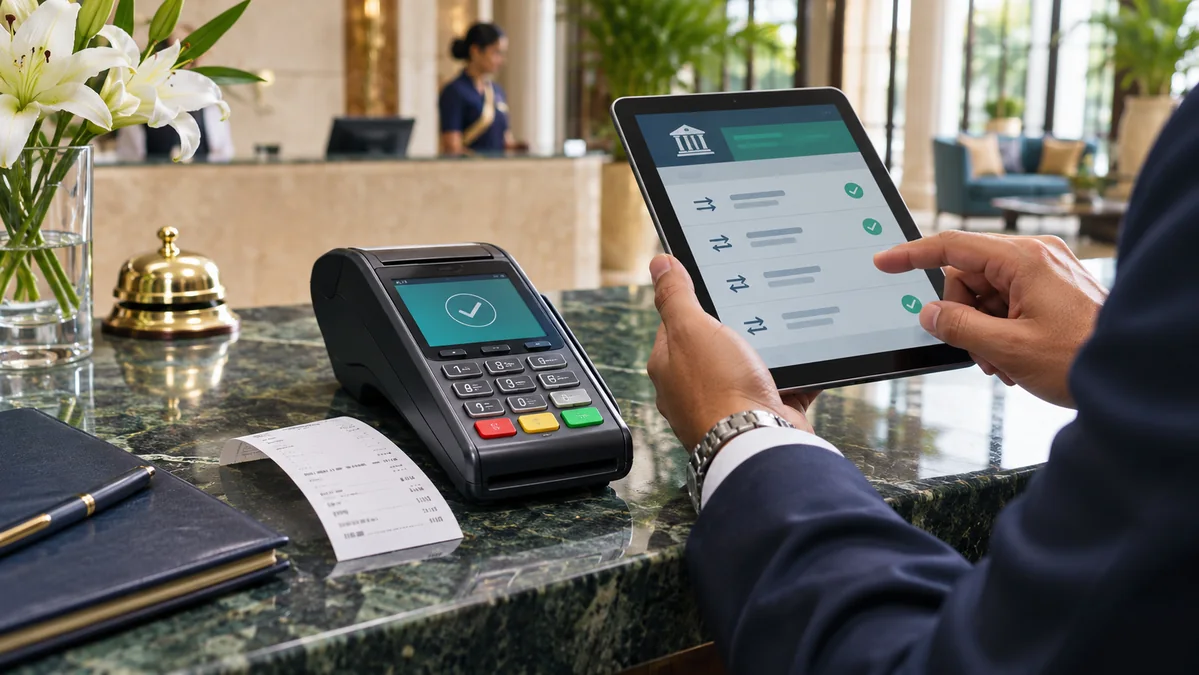
A hotel night audit is the daily check that brings room activity, outlet sales, guest accounts and collections together for one business date. The aim is to explain the day’s figures and leave a reliable handover for the next shift. Completing the night audit system run alone does not prove that every room charge, payment or transfer is correct.
This guide follows a small hotel through a missing restaurant posting, a cash shortage and a guest-ledger reconciliation. The figures are illustrative. Use your property’s authorised procedures, system configuration and accounting policy when applying the checklist.
What the hotel night audit should establish
- The business date and the reporting period are clear.
- Rooms sold, room status and agreed rates have been checked.
- Room, food and beverage, and other charges are complete and supported.
- Cash, card, UPI, deposits and direct-bill transfers are accounted for separately.
- Unresolved differences have an amount, evidence, an owner and a follow-up date.
Night audit and income audit often overlap, but responsibility varies between properties. The night team may close cashiers and run end of day, while finance checks adjustments and supporting records the following morning. Agree who can approve each correction and who gives the final sign-off.
1. Start with the business date
A business date can differ from the calendar date on the clock. A transaction entered after midnight may belong to the previous hotel business date under the property’s cut-off procedure. Write the business date on the audit pack and use it consistently across PMS, POS, cashier and settlement reports.
Before starting night audit, confirm which arrivals, departures, open checks and cashiers need attention. Resolve them through the approved workflow. Do not check out a guest, mark a booking as a no-show or close an outlet check merely to clear a warning.
System sequencing also matters. Oracle’s OPERA Cloud End of Day documentation explains that the business date may advance while further posting, balancing and reporting procedures continue. Check the status of the complete run, not just the displayed date. Other PMS products and configurations may use different steps.
2. Collect the records before making corrections
Save a dated starting pack for night audit: room-status and rate reports, arrivals and departures, outlet sales, guest and deposit ledgers, cashier summaries, card batch totals, UPI reports and the adjustment log. Use the same period and currency. Keep the original exports so the reviewer can see what changed.
Record references rather than copying full card details or unnecessary guest information into the audit sheet. Restrict access to folios and supporting records under the hotel’s data-handling policy.
3. Worked example: find a missing restaurant posting
For the business date 5 November 2026, a 120-room hotel has 100 paid occupied room nights. There are no complimentary or day-use rooms in this simplified example. All revenue figures below exclude tax.
| Revenue line | Supported amount | PMS before review | Difference |
|---|---|---|---|
| Room revenue | ₹2,40,000 | ₹2,40,000 | ₹0 |
| Food and beverage | ₹96,000 | ₹94,000 | ₹2,000 short |
| Laundry and other charges | ₹4,000 | ₹4,000 | ₹0 |
| Approved F&B allowances | (₹6,000) | (₹6,000) | ₹0 |
| Net revenue | ₹3,34,000 | ₹3,32,000 | ₹2,000 short |
The POS report supports ₹96,000 of food and beverage charges assigned to guest folios, but only ₹94,000 reached the PMS. For simplicity, this example has no separately settled walk-in outlet sales. In a real hotel, separate room-charge transfers from cash, card and other outlet tenders before comparing totals.
The auditor traces the ₹2,000 difference to one closed restaurant check that did not transfer through the interface. They check the outlet check number, guest authorisation, room and folio, business date and interface status. They also search for a duplicate posting before asking an authorised user to correct it.
After the approved correction, food and beverage postings become ₹96,000 and net revenue becomes ₹3,34,000. Keep the original check, correction reference and approval together. Do not rerun an entire posting batch without checking whether other transactions have already posted.
What about the journal entry?
If the missing charge is absent from the accounting records as well, the usual direction is a debit to the relevant guest receivable and a credit to food and beverage revenue, with the applicable tax treatment recorded separately. The actual accounts depend on how the PMS exports to the general ledger. If the general ledger already contains the POS revenue, correct the interface or clearing difference rather than recognising the sale twice.
4. Prove the guest-ledger movement
Use the night audit pack to reconcile the guest ledger once charges are complete. Assume opening guest balances of ₹1,80,000, corrected net charges of ₹3,34,000 and separately verified tax postings of ₹36,000. The tax amount is an input for this illustration, not a rate calculation or a GST determination.
| Movement | Amount |
|---|---|
| Opening guest ledger | ₹1,80,000 |
| Add: net charges | ₹3,34,000 |
| Add: verified tax postings | ₹36,000 |
| Less: payments and deposit applications | (₹3,00,000) |
| Less: authorised direct-bill transfers | (₹80,000) |
| Expected closing guest ledger | ₹1,70,000 |
Compare ₹1,70,000 with the closing PMS guest-ledger report for the same business date. A direct-bill transfer moves an approved balance from the guest ledger to the city ledger or another receivable. It is not a bank receipt and does not create new revenue.
In this example, the ₹3,00,000 reduction comprises cash ₹45,000, card ₹1,80,000, UPI ₹35,000 and advance deposits applied ₹40,000. Applying a deposit reduces the deposit liability and the guest balance; it is not a fresh cash collection. Follow both sides of each transfer so the reconciliation does not hide a difference in another ledger.
5. Check cash independently of revenue
The cashier’s recorded cash collection is ₹45,000. With an opening float of ₹10,000, approved paid-outs of ₹2,000 and a documented safe drop of ₹40,000, the expected cash left in the drawer is:
₹10,000 + ₹45,000 − ₹2,000 − ₹40,000 = ₹13,000
The witnessed count is ₹12,500, leaving a ₹500 shortage. Recount, check denominations, confirm the safe-drop receipt and review paid-outs, refunds and tender corrections. A payment recorded as cash but received by card can cause a tender difference without changing revenue.
If the shortage remains, record it in the exception log and escalate it under the hotel’s cash-handling policy. Do not reduce room revenue or create an unsupported allowance to make the drawer balance. Any accounting entry or recovery needs the appropriate approval.
6. Keep card and UPI timing differences visible
As part of night audit, match card batches and UPI transaction totals to the tender records for the business date. Then track their settlement to the bank using transaction or batch references. Fees, refunds, chargebacks, cut-off timing and pending settlements can make the bank credit different from the gross collection.
A ₹1,80,000 card batch awaiting settlement should remain supported as a receivable or clearing item under the hotel’s accounting process. It should not be marked received in the bank simply because the guest’s folio is settled. Use the separate Hotel Payment Settlement Reconciliation guide for the bank-matching stage.
7. Review room statistics on the same basis
Using the simplified room figures above, occupancy is 100 ÷ 120 × 100 = 83.33%. Average daily rate is ₹2,40,000 ÷ 100 = ₹2,400, and revenue per available room is ₹2,40,000 ÷ 120 = ₹2,000.
These checks use room revenue only, excluding tax and non-room revenue. The ₹6,000 allowance in this example relates to food and beverage, so it does not reduce the ₹2,40,000 room-revenue figure. In practice, document how the hotel treats out-of-order rooms, complimentary rooms, day use and package allocations. Compare reports only when their definitions match.
Hotel night audit checklist for the handover
Mark each item Done, Exception or Not applicable. An exception should refer to a named owner and supporting evidence.
| Check | Evidence to retain | Suggested owner |
|---|---|---|
| Confirm business date and cut-off | Audit cover sheet and system date | Night auditor |
| Review arrivals, departures and room status | Exception report and approved action | Front office |
| Check rates, packages and room charges | Rate check and posting report | Night auditor |
| Reconcile outlet room-charge transfers | POS totals, PMS totals and check references | Night auditor / outlet |
| Review allowances, voids and refunds | Reason, original transaction and approval | Duty manager |
| Reconcile guest and deposit ledgers | Opening, movement and closing reports | Night auditor / finance |
| Check direct-bill transfers | Approved billing instruction and both ledger entries | Front office / credit control |
| Count cash and confirm safe drops | Signed count, paid-outs and drop receipts | Cashier / witness |
| Match card and UPI batches | Tender report and pending-settlement schedule | Night auditor / finance |
| Review room statistics | Occupancy, ADR and RevPAR calculation basis | Night auditor |
| Complete the authorised end-of-day sequence | Run status, posting errors and final report references | Authorised system user |
| Hand over unresolved items | Exception log, owner, due time and review sign-off | Night auditor / incoming reviewer |
What a useful exception log looks like
For the missing restaurant posting, record: business date 5 November; POS check reference NA-105; difference ₹2,000; cause “room-charge interface transfer missing”; owner “front-office supervisor”; action “verify and post once through the approved workflow”; and the correction reference when completed. These are illustrative references, not actual guest records.
In the night audit exception log, record the ₹500 cash shortage as a separate item with its own investigation and approval trail. Do not net it against the ₹2,000 revenue posting. The differences have different causes, owners and accounting consequences.
Common questions
Does night audit have to happen exactly at midnight?
The timing depends on the hotel’s business-date policy and system setup. Agree the cut-off and handover process, especially for late-night outlets. Avoid changing the cut-off informally from one shift to another.
Can I rerun night audit if the totals look wrong?
Check the run status and error reports first. Follow the PMS support procedure and the property’s authorisation rules. A repeat run or manual posting can duplicate charges if the original process partly completed.
Is a zero difference enough to sign off?
No. Equal totals can conceal a wrong account, duplicate charge offset by a missing charge, or an unsupported adjustment. Check the underlying references, approval and cut-off as well as the arithmetic.
Continue the hotel finance workflow
- Hotel Daily Revenue Reconciliation Checklist — follow the daily income-audit controls.
- Hotel Payment Settlement Reconciliation — track card, UPI and OTA receipts to the bank.
- Accounts Receivable Month-End Close — review balances after direct billing and collection.
Source and scope
The system-specific reference is Oracle Hospitality: About End of Day. The worked figures and checklist are TaxNexus educational illustrations. They are not a vendor-certified operating procedure, an audit opinion or tax advice. Confirm your hotel’s approved accounting and system procedures before posting adjustments.