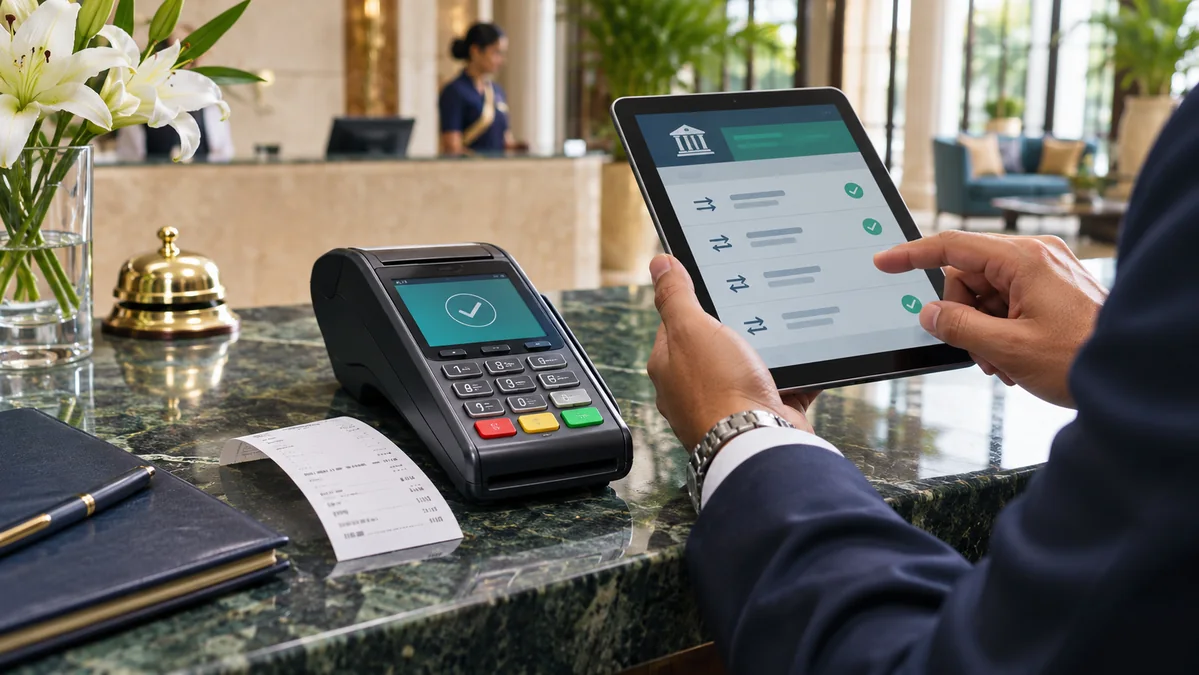
The night audit has finished, but the daily report still needs a finance review. Room revenue, restaurant sales, guest payments and bank receipts answer different questions. A useful daily reconciliation checks the source totals, explains transfers between systems and leaves a short list of exceptions for follow-up.
Begin with one hotel and one business date. Keep that date visible on every report. A transaction entered after midnight may still belong to the previous hotel business date, so confirm each system’s cutoff before comparing totals.
1. Save the reports before adjusting anything
- PMS trial balance, revenue summary and transaction journal.
- POS sales summary, tender report and room-charge transfer listing.
- Cashier closures, cash count sheets and deposit records.
- Card and UPI transaction reports with merchant references.
- Guest, city or accounts-receivable and advance-deposit ledger movements.
- Voids, discounts, allowances, refunds and complimentary approvals.
Keep original exports in the close folder. Re-running a report after a correction can change the comparison. Record the version used, the adjustment reference and who reviewed it. The exact report names and ledger structure depend on your PMS configuration.
2. Reconcile revenue by department
Compare room revenue with the rate and occupancy records, then review exceptions such as complimentary stays, late adjustments and packages. Compare food-and-beverage revenue with the POS, allowing for documented differences in tax presentation, business date and room-charge interfaces. Check banquet and other operating revenue against the supporting event or sales records.
Use a consistent net or gross basis. If one report includes tax and another excludes it, separate the tax before calling the difference an error. Review service-charge and package allocations under the property’s accounting policy. A package transfer between internal ledgers can change department totals without creating another guest sale.
3. Prevent room-charge double counting
Suppose the restaurant POS reports ₹2,00,000 of net sales. Of this, ₹60,000 is charged to guest rooms and transferred to the PMS. If the consolidated PMS revenue report already includes that ₹60,000 as restaurant revenue, adding all POS sales again duplicates the room-charge portion.
For an illustration, rooms are ₹5,00,000, food and beverage is ₹2,00,000 and other revenue is ₹50,000. Total revenue is ₹7,50,000. If a combined report shows ₹8,10,000, the ₹60,000 room-charge transfer is one item to investigate. Verify the actual interface mapping and posting trail before correcting anything.
4. Reconcile the guest ledger as a separate movement
| Illustrative guest-ledger movement | Amount |
|---|---|
| Opening guest receivables | ₹3,00,000 |
| Add current guest charges including tax | ₹4,50,000 |
| Less cash payments | ₹1,00,000 |
| Less card and UPI payments | ₹2,00,000 |
| Less transfers to city ledger | ₹50,000 |
| Less deposits applied to guest accounts | ₹40,000 |
| Closing guest receivables | ₹3,60,000 |
This ledger example is independent of the department revenue example. It covers only the guest-ledger population. Other outlets, tax entries, prior balances and transfers can explain why it does not equal the day’s revenue. When ₹50,000 moves to the city ledger, verify the corresponding receivable there. Applying a deposit also requires the matching reduction in the deposit liability.
5. Match each payment type to its evidence
Compare recorded cash with the cashier count, approved paid-outs, float movement and cash drop. For cards and UPI, match successful merchant transactions to PMS payments and retain settlement references. Money arriving in the bank on another date belongs in the payment-clearing reconciliation. Review guest advances separately from revenue and retain a clear trail when an advance is applied or refunded.
6. Close the exceptions with an owner
- Check missing interface batches and duplicated room-charge postings.
- Investigate unsupported voids, discounts and allowances.
- Trace refund approval to the payment and guest account.
- Reconcile guest, city and deposit-ledger transfers on both sides.
- Record each unresolved item with amount, reason, owner and next review date.
- Tie approved daily summaries to the ERP posting batch and retain reviewer sign-off.
A daily file is complete when another reviewer can follow the totals and understand the remaining exceptions. Keep routine timing differences separate from errors requiring correction. Where the hotel uses OPERA, consult the reports and financial handling guidance for its installed version, since ledger behaviour and available controls can vary.
- Oracle Hospitality Trial Balance Report
- Oracle Hospitality Financial Handling Examples
- Hotel payment settlement reconciliation
- Accounts receivable month-end close
- Bank reconciliation
Prepared by the TaxNexus Editorial Team. Last reviewed 6 November 2026. All amounts and business records in the worked examples are illustrative. Apply your organisation’s accounting policies and review the applicable tax treatment before posting entries.