Key terms checked: 24 October 2026. Cashback rates, fees, caps, exclusions and eligibility can change. Always confirm the latest terms on the card issuer’s website before applying.
The best cashback credit cards in India can reduce the effective cost of everyday spending, but the card with the highest advertised rate is not automatically the best choice. Monthly caps, excluded transactions, annual fees and spending thresholds can substantially change the value you actually receive.
This TaxNexus comparison includes only cards whose key cashback terms were checked against current issuer information. It is a practical shortlist, not a universal ranking or a recommendation to borrow.
For a practical framework before comparing products, read our guide to choosing a cashback credit card in India. It explains fees, cashback caps, exclusions and why paying the total amount due on time matters.
Best cashback credit cards in India: compare net value fairly
Use the same monthly spending pattern for every card. Split it into online purchases, groceries or dining, UPI, utilities and excluded payments. Apply each card’s category rules and statement-cycle cap before comparing annual fees. A 10% headline rate on a narrow category cannot be compared directly with 5% across a wider set of eligible purchases.
We compare the four cards below on earning categories, caps, fees, redemption and important conditions. This is a selected comparison, not a ranking of every Indian card. Issuer product pages and terms are the verification sources; advertisements or aggregator badges do not establish that an offer suits you.
Worked example: cashback after a fee
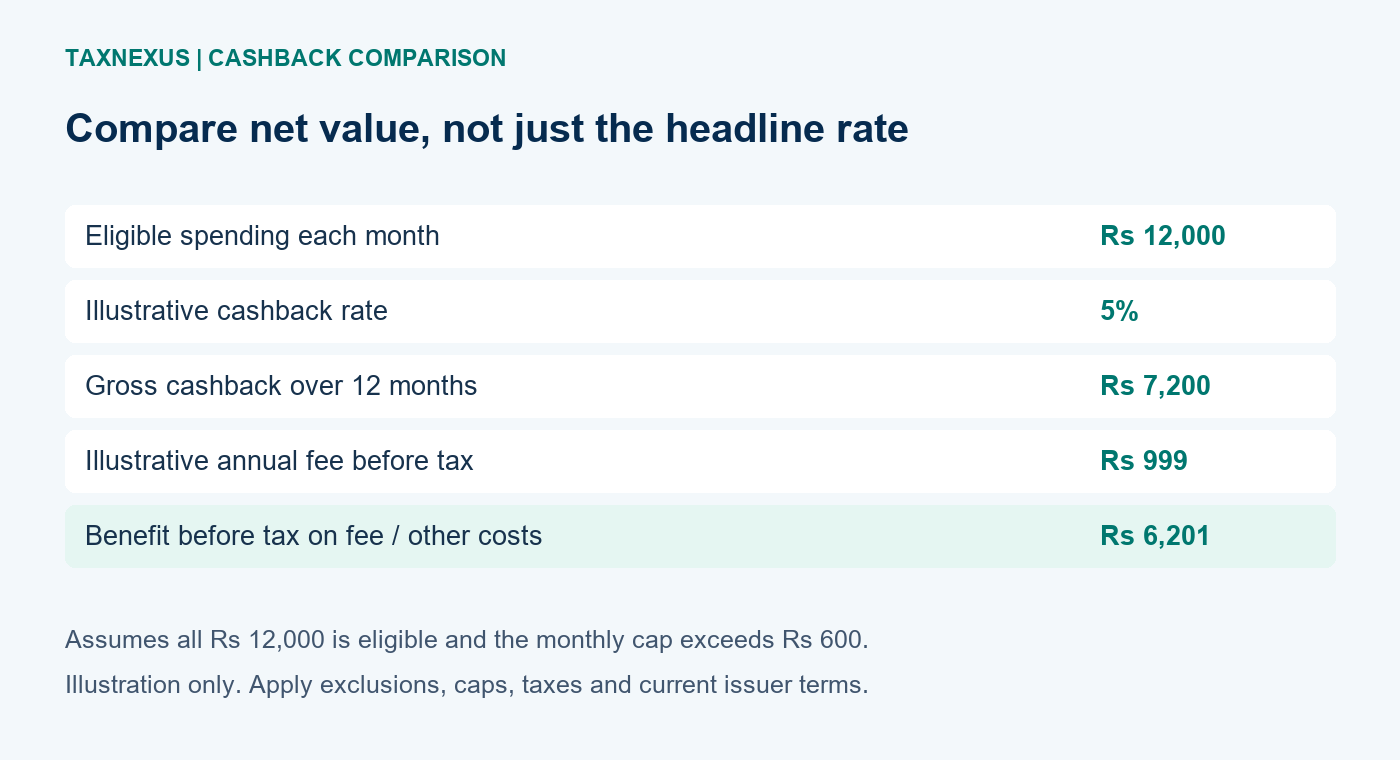
For an illustrative card, assume ₹12,000 of eligible monthly online purchases earning 5%, a monthly cap above ₹600, and an annual fee of ₹999 plus applicable tax. Gross cashback would be ₹600 per month or ₹7,200 over twelve identical months. Before tax on the fee, net benefit would be ₹7,200 − ₹999 = ₹6,201; the final net amount is lower once that tax or other charges apply. This is arithmetic under stated assumptions, not a quoted benefit for every card.
If half the spending is excluded, eligible cashback falls to ₹300 per month under the same example. Recalculate from your real spending and do not count a fee waiver unless its conditions are met. For the full selection checklist, read how to choose a cashback credit card.
Quick comparison
| Card | May suit | Core cashback | Fee and cap snapshot |
|---|---|---|---|
| HSBC Live+ | Dining, food delivery, groceries, shopping and utilities | 10% on eligible accelerated categories; 1.5% on most other eligible spends | ₹999 joining and annual fee; accelerated cashback capped at ₹1,200 monthly; annual fee waiver above ₹2 lakh eligible annual spend |
| IDFC FIRST Hello Cashback | FD-backed card for eligible online, bank-app UPI and in-store spending | 3% on eligible online spends up to ₹10,000 and 5% on incremental eligible online spends above ₹10,000 | Standard joining and annual fee ₹1,000 each plus GST; joining-fee promotions may apply. Online cashback cap ₹1,000; overall cap ₹1,500 per statement cycle; annual-fee reversal conditions apply |
| CASHBACK SBI Card | Broad eligible online spending | 5% on eligible online transactions and 1% on eligible offline transactions | ₹999 joining and annual fee; maximum ₹2,000 online plus ₹2,000 offline cashback per statement cycle; renewal-fee waiver at ₹2 lakh annual spend |
| Amazon Pay ICICI Bank Credit Card | Regular Amazon and Amazon Pay users | 5% on Amazon India for eligible Prime members, 3% for eligible non-Prime members, 2% on eligible Amazon Pay partner spends and 1% on other eligible payments | No joining or annual fee; issuer states no limit on earnings |
The comparison is simplified. Merchant categories, statement-cycle calculations, exclusions, reversals and other conditions apply.
1. HSBC Live+ Credit Card
Best considered for: people who spend regularly on dining, food delivery, groceries, shopping and utilities and can use enough of the monthly accelerated-cashback allowance.
- 10% accelerated cashback on eligible dining, food delivery, grocery, shopping and utility spends.
- The accelerated cashback is capped at ₹1,200 per month.
- 1.5% unlimited cashback on most other eligible spending, subject to exclusions.
- Joining fee: ₹999.
- Annual fee: ₹999, waived when the issuer’s eligible annual-spend condition above ₹2 lakh is met.
Why it stands out: the accelerated rate can be valuable when your normal monthly expenses fall inside the eligible categories. However, the ₹1,200 monthly cap means the headline 10% rate stops adding value after a certain level of eligible spending.
Check before applying: confirm merchant-category eligibility, excluded transactions, the annual-fee waiver rule and whether your typical merchants are coded in qualifying categories.
2. IDFC FIRST Hello Cashback Credit Card
Best considered for: users comfortable maintaining an FD-backed card who understand the incremental online cashback tiers and separate caps.
- 3% cashback on eligible online spends up to ₹10,000 in a statement cycle.
- 5% cashback on incremental eligible online spends above ₹10,000.
- 1% cashback on eligible UPI spends made through the IDFC FIRST Bank app.
- 1% cashback on eligible in-store and specified essential-category spends.
- An additional 1% applies to eligible hotel and flight bookings made through the bank app, subject to issuer terms.
- Online cashback is capped at ₹1,000 per statement cycle; total cashback, including eligible bonus cashback, is capped at ₹1,500.
- The card is FD-backed; the issuer currently specifies a minimum fixed deposit of ₹10,000. Consider the deposit commitment as well as the cashback.
- Standard joining fee and annual fee: ₹1,000 each, plus applicable taxes. A promotional joining-fee waiver may apply; check the issuer’s live offer and expiry. The annual-fee reversal is ₹500 for eligible annual spends from ₹1 lakh to below ₹2 lakh and ₹1,000 for eligible annual spends of ₹2 lakh or more.
Why it stands out: the tiered structure can reward a user who naturally spends online each month without changing behaviour simply to chase cashback.
Check before applying: the 5% rate applies to incremental eligible online spending above the threshold, not necessarily to the entire month’s online spend. Confirm current fees, exclusions, cashback posting rules and any category-specific limits.
3. CASHBACK SBI Card
Best considered for: users who want a simple cashback structure across a wide range of eligible online and offline transactions.
- 5% cashback on eligible online transactions.
- 1% cashback on eligible offline transactions.
- Online cashback is capped at ₹2,000 and offline cashback at ₹2,000 per statement cycle; aggregate cashback cannot exceed ₹4,000 per statement cycle.
- Joining fee: ₹999. Annual fee: ₹999, waived on eligible annual spends of ₹2 lakh or more in the preceding year.
- Exclusions include utility, insurance, fuel, rent, wallet loads, education, jewellery, railways, government payments, tolls, gaming, EMI and other categories listed by SBI Card.
Why it stands out: the 5% online rate applies across many eligible online merchants rather than only one shopping platform. The separate online and offline caps introduced from 1 April 2026 should be included in your value calculation.
Check before applying: confirm that your normal online categories are eligible, since the exclusion list is extensive and can materially reduce expected cashback.
4. Amazon Pay ICICI Bank Credit Card
Best considered for: frequent Amazon India shoppers who prefer a lifetime-free card and are comfortable receiving rewards as Amazon Pay balance.
- No joining fee or annual fee.
- Eligible Amazon Prime members earn 5% back on qualifying Amazon India purchases.
- Eligible non-Prime members earn 3% back on qualifying Amazon India purchases.
- 2% back on eligible Amazon Pay partner-merchant spending and 1% on other eligible payments.
- The issuer states there is no limit on earnings; rewards are automatically converted to Amazon Pay balance after each billing cycle.
Why it stands out: its fee-free structure makes the net benefit easier to evaluate, particularly for existing Amazon customers.
Check before applying: the highest rate depends on Prime membership and eligible Amazon purchases. Cashback is issued as Amazon Pay balance rather than a direct bank-account credit.
Which one may fit you?
- Category-led household spending: HSBC Live+ may fit when dining, food delivery, groceries, shopping and utilities form a meaningful share of your monthly budget.
- Tiered online and UPI spending: IDFC FIRST Hello Cashback may fit when eligible online purchases regularly exceed ₹10,000 per statement cycle.
- Broad online spending: CASHBACK SBI Card may fit when your usual online merchants are not part of its exclusion list.
- Amazon-focused spending without an annual fee: Amazon Pay ICICI Bank may fit frequent Amazon users, especially eligible Prime members.
- Calculate net value: subtract annual fees from expected cashback, apply every cap and do not count welcome benefits you may not use.
- Never overspend for rewards: cashback rarely compensates for interest or late-payment charges.
How to calculate your real annual benefit
Use a simple estimate:
Net annual benefit = expected cashback − annual fee − extra costs caused by using the card
Base the estimate on your last three to six months of real spending. Separate eligible and excluded categories, apply monthly caps, and avoid assuming that every payment earns the advertised rate. If you carry a balance, finance charges can erase months of cashback very quickly.
Important checks before you apply
- Read the issuer’s latest key fact statement, schedule of charges and reward terms.
- Review exclusions such as rent, fuel, wallet loads, government payments, education or other restricted categories.
- Confirm whether cashback is automatic, appears as a statement credit or requires redemption.
- Check monthly and annual caps, minimum transaction values and reversal rules.
- Pay the total amount due by the due date whenever possible.
- Do not submit multiple applications within a short period only to chase offers.
Frequently asked questions
Which is the best cashback credit card in India?
There is no single best card for everyone. The better choice depends on your eligible spending categories, monthly spending level, fee waiver conditions, credit profile and ability to pay the bill in full.
Does cashback have a monthly limit?
Often yes. Accelerated cashback commonly has a monthly or statement-cycle cap. After the cap is reached, additional spending may earn a lower rate or no cashback, depending on the issuer’s rules.
Is cashback taxable in India?
Ordinary purchase rebates are generally treated differently from income, but individual circumstances and promotional structures can vary. Consult a qualified tax professional if the amounts are material or connected with business spending.
Will applying affect my credit score?
A card application may result in a hard credit enquiry. Multiple enquiries in a short period can affect how lenders assess your profile. Approval is always subject to the issuer’s eligibility and underwriting.
Should I carry a balance to earn more cashback?
No. Credit-card interest and late fees are normally much higher than the cashback earned. Rewards are most useful when you spend within budget and pay the total amount due on time.
Which cashback credit card has no annual fee?
The Amazon Pay ICICI Bank Credit Card currently has no joining or annual fee. Other cards may waive or reverse annual fees only after eligible spending thresholds are met.
Which card offers 5% cashback on online spending?
CASHBACK SBI Card offers 5% cashback on eligible online transactions, subject to its separate online cap and exclusions. IDFC FIRST Hello Cashback offers 5% only on incremental eligible online spending above ₹10,000 in a statement cycle. Amazon Pay ICICI Bank offers 5% on qualifying Amazon India purchases for eligible Prime members.
Affiliate disclosure: TaxNexus may earn a commission if you later use an eligible partner link, at no additional cost to you. This page currently links to official issuer information for verification. Commercial relationships do not determine our editorial conclusions. Read our Affiliate Disclosure.
Editorial note: This content is for education and comparison only. It is not financial, tax or legal advice. Product availability, approval, pricing and benefits are controlled by the card issuer.