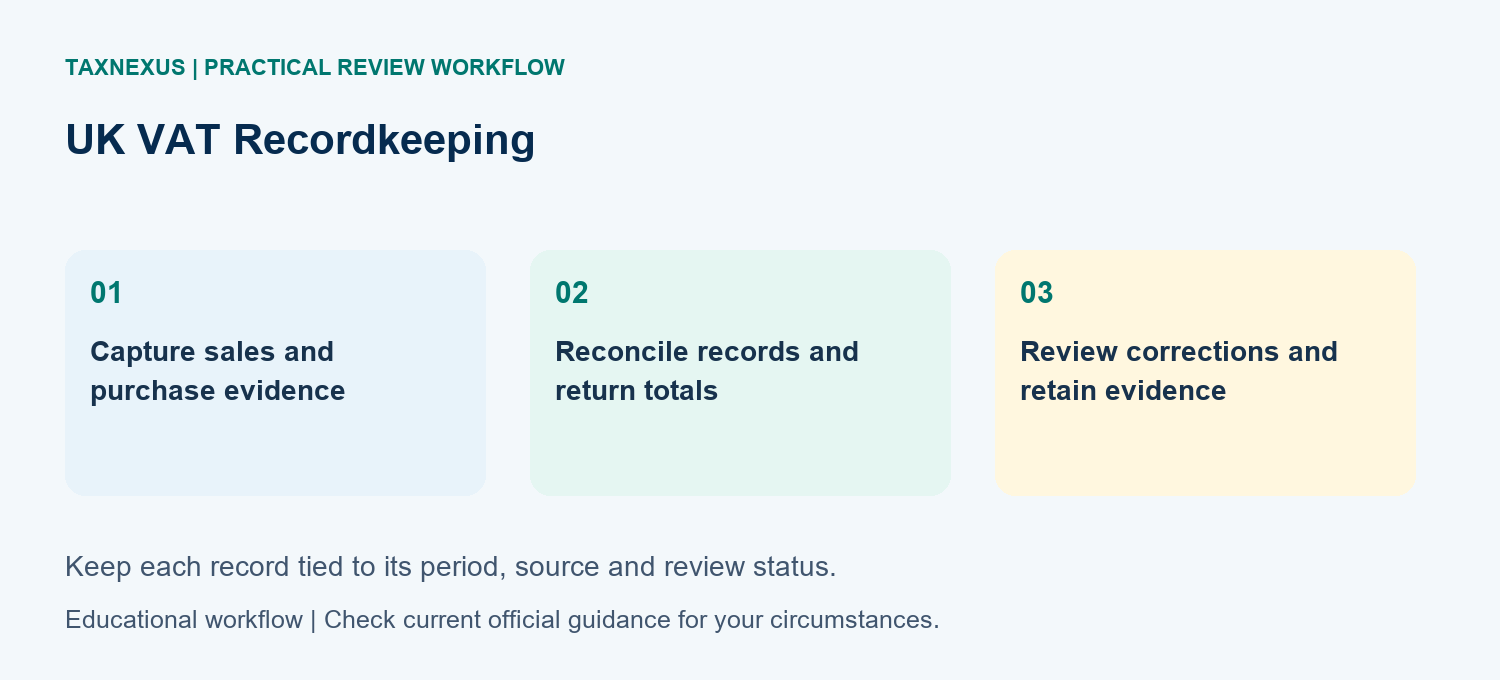
UK VAT Recordkeeping Guide
Organise VAT invoices, digital records and return support with a repeatable compliance workflow.
Quick answer
VAT-registered businesses must keep records supporting output tax, input tax and submitted returns. Many businesses must also follow Making Tax Digital requirements using compatible software and digital links.
Core VAT records
- Sales and purchase invoices.
- Credit notes, debit notes and import or export evidence.
- VAT account and return workings.
- Records of adjustments, partial exemption or special schemes.
- Digital links between source records and return figures where required.
Return preparation workflow
- Close the VAT period and ensure transactions are posted.
- Reconcile sales, purchases and VAT control accounts.
- Review unusual, zero-rated, exempt and reverse-charge items.
- Document adjustments and approval.
- Submit through compatible software and retain confirmation.
Quality controls
Restrict editing after a period is closed, document corrections and review supplier invoices before claiming input tax. Keep a clear audit trail from the return boxes back to the underlying transactions.
VAT recordkeeping: build an evidence trail
Use a transaction register that connects each reported figure to an invoice or other supporting document. Helpful fields include document date, invoice number, supplier or customer, net amount, VAT amount, gross amount, tax treatment and the accounting period used. Mark unresolved VAT treatment for review instead of choosing a rate only to make the return balance.
A practical pre-submission review
- Compare sales totals with your accounting records and explain differences caused by timing, credit notes or adjustments.
- Review purchase entries for duplicate invoices and missing documents. A bank payment alone does not explain the nature or VAT treatment of a purchase.
- Keep credit notes linked to the original invoice so corrections remain understandable.
- Review unusual items separately, including imports, overseas services, mixed business and private use, and transactions outside ordinary domestic sales.
- Save the return working papers, submission acknowledgement and payment record together. Keep a written explanation of adjustments.
Example: finding a duplicate purchase
A supplier invoice appears once through an email import and again through a manual entry. The bank contains only one payment. Matching the supplier, invoice number and gross value can reveal the duplicate before it affects the VAT working papers. Remove or correct the duplicate through a traceable process rather than forcing the reconciliation with an unexplained journal.
Digital records and exceptions
Check HMRC’s current Making Tax Digital rules for the digital records, software and links required for your circumstances. Retain evidence of any applicable exemption rather than assuming a spreadsheet by itself satisfies every requirement. An accounting reconciliation is a review control; it is not proof that every purchase qualifies for input VAT recovery. Ask an adviser about uncertain eligibility before submission. Continue with the separate MTD for Income Tax guide if that regime also concerns you; VAT and Income Tax obligations are different.
VAT recordkeeping after the review
Save the version of the working papers that supported the submitted return. Record who reviewed the exceptions and how each material difference was resolved. If a later correction becomes necessary, keep it linked to the earlier period rather than overwriting the explanation and losing the trail.
For recurring suppliers, a consistent invoice reference makes duplicate checking easier. Where a document is missing, keep the open question visible and assign a follow-up date. An approved payment and a valid VAT recovery claim are separate questions. The review should explain both the transaction recorded and the evidence used for its treatment.