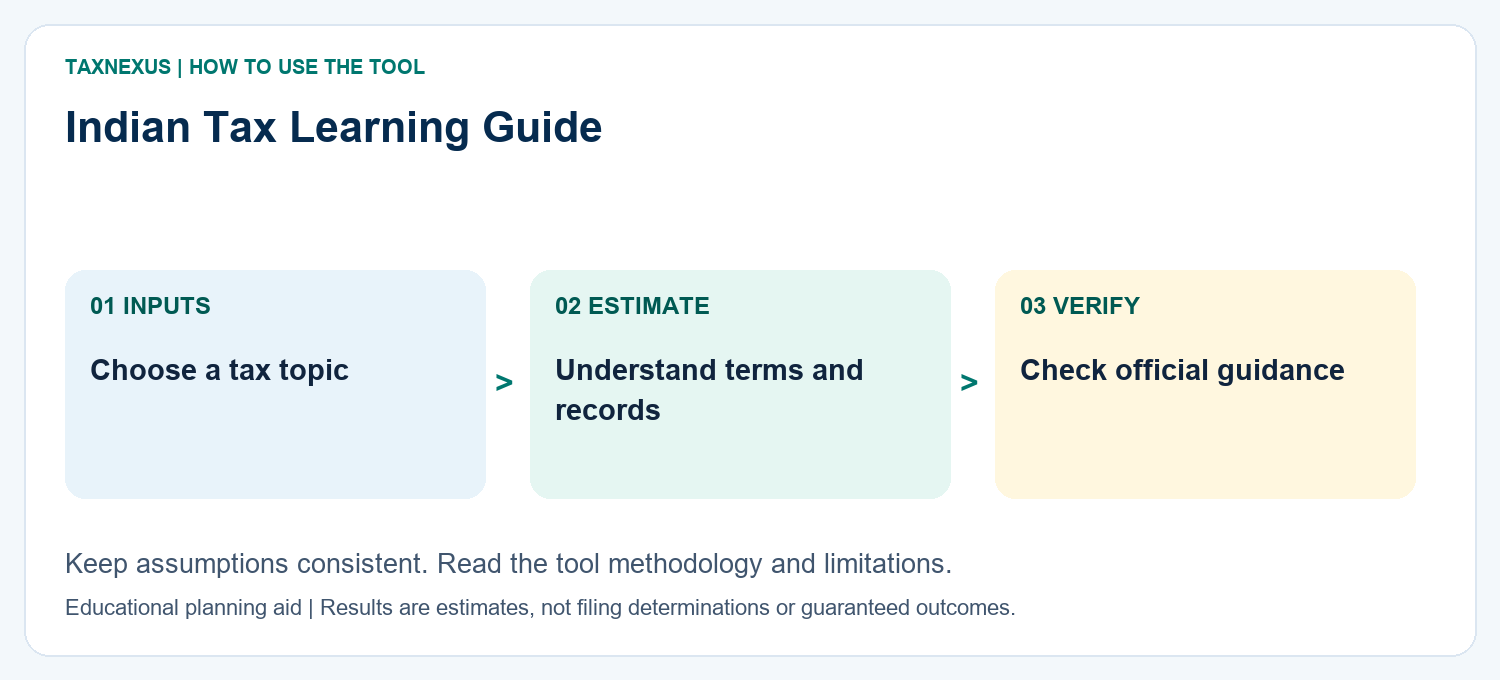
This tax explainer is an editorial learning guide for Indian tax questions. Start with the relevant period and source records, choose an appropriate guide or calculator, and verify the result with official instructions.
Indian Tax Learning Guide
Use this page to find practical explanations and tools for Indian income tax. The interactive AI answer service is not active; this page provides editorial guides and calculators instead of accepting questions.
Start with the year and the question
Before comparing a tax calculation, identify the period the income relates to, the type of income and the applicable law. A guide for an earlier assessment year may use different section numbers, rates or conditions. Do not combine a deduction from one regime with rates from another without checking the rules.
The Income-tax Act, 2025 introduces a new legal framework from 1 April 2026. Older assessment-year guides may still refer to the Income-tax Act, 1961. Check the period stated on each article and use the Department’s official explanations when moving between the two frameworks.
Choose the right starting point
- Income Tax hub: filing concepts, records and related explanations.
- Old vs New Tax Regime Calculator: compare the assumptions supported by the tool for its stated period.
- HRA calculator: explore salary and rent assumptions where the relevant exemption applies.
- TDS late-fee and interest calculator: understand a preliminary estimate and check its scope.
Understand three different concepts
A deduction generally reduces the income used in the relevant calculation. An exemption may exclude qualifying income subject to conditions. A rebate reduces calculated tax when its requirements are satisfied. They are not interchangeable. A reference to a section alone does not establish that a taxpayer is eligible.
Work through an illustrative question
Suppose an employee wants to compare two tax regimes. First collect salary information and identify other income. Next list deductions or exemptions that are actually available for the applicable period. Enter consistent figures into the comparison tool. Finally review the treatment of special-rate income, surcharge and other adjustments in the tool notes. A smaller displayed number is useful for discussion, but does not establish a final filing position.
Protect personal information
Do not send PAN, Aadhaar, passwords, OTPs, bank details or tax-return files through general website forms. To report a calculator problem, send the page address, an anonymised example and the result you expected. Remove personal and employer-confidential details before contacting us.
Verify with official sources
Tax explainer: 4 steps for a clearer question
- Describe the event. Identify whether the question concerns salary, a sale, a deduction, a payment or a filing step. Keep a factual description separate from an assumption about the tax outcome.
- Identify the period. Record when the income arose and which return or tax year is being considered. A familiar section label may refer to a different legal framework.
- Gather the relevant evidence. Use statements, invoices or payroll records appropriate to the question. Keep confidential documents privately and use fictional figures for a general demonstration.
- State the unresolved point. Explain whether you need a definition, an arithmetic check, an eligibility review or a portal instruction. Those questions can require different resources.
How to read an example
An example illustrates a method using stated assumptions. It does not establish that the same conditions apply to every taxpayer. Check which facts were assumed and which items were excluded before comparing it with your situation.
Use this tax explainer to organise the next review step. Keep a note of the official source checked and any remaining uncertainty rather than treating a single calculator number as a complete answer.