UK Limited-Company Accounting Guide
Understand the records, accounts and recurring compliance tasks of a UK private limited company.
Quick answer
A limited company must maintain accounting and company records, prepare annual accounts, meet Companies House obligations and handle Corporation Tax requirements with HMRC.
Records to maintain
- Sales, purchases, expenses and bank transactions.
- Assets, liabilities, stock and financing records.
- Payroll and director transaction records.
- Share, officer and statutory company information.
- Supporting documents and reconciliations.
Recurring workflow
- Reconcile accounts monthly and review director or shareholder balances.
- Prepare year-end accounts from clean ledgers.
- Submit accounts and confirmation information by the relevant deadlines.
- Prepare and file the Company Tax Return and pay Corporation Tax.
- Retain records for the required period.
Director responsibility
Directors remain responsible for records and filings even when an accountant prepares them. Review submissions, keep access to source documents and monitor deadlines in a shared compliance calendar.
Company accounting: a monthly close you can repeat
A useful accounting file should let another person trace a reported balance back to its supporting evidence. Organise the month by bank account, sales, supplier invoices, payroll, fixed assets and director transactions. Keep a short exception list for missing documents rather than silently guessing an expense category.
- Match each bank and card statement to the ledger. Investigate unmatched items, duplicated imports and transfers between your own accounts.
- Compare customer balances with invoices and receipts. Separate overdue debts, credit notes and money received before an invoice is raised.
- Review supplier balances against statements. Record the reason for any disputed or unapproved invoice.
- Maintain a fixed-asset schedule with purchase evidence, business use, disposal details and accounting treatment for your accountant to review.
- Record director funding and reimbursements separately from trading revenue. Do not label a withdrawal as salary or a dividend merely because cash left the company.
Example: why bank balance is not profit
Suppose a company receives £8,000 from customers and £5,000 as director funding, then pays £4,000 to suppliers. Its cash increases by £9,000, but that does not mean it earned £9,000 profit. The funding is a separate balance-sheet transaction; unpaid invoices, accruals and other adjustments can also change the accounting result. This example illustrates record classification, not Corporation Tax computation.
Year-end handover checklist
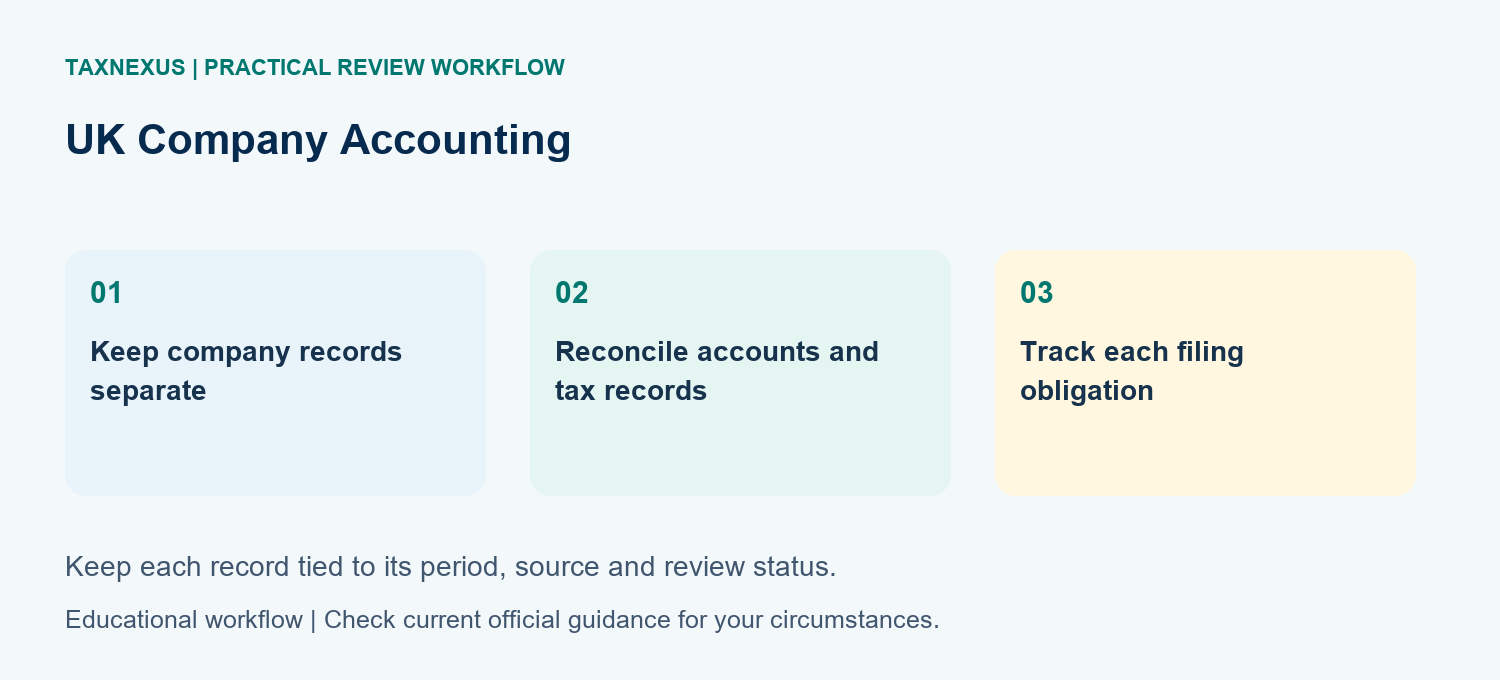
Give the preparer a reconciled trial balance, bank statements, debtor and creditor schedules, asset register, payroll reports and a list of unresolved items. Track Companies House accounts, the confirmation statement, HMRC filing and payment obligations as separate calendar entries: completing one does not complete the others. Ask the preparer to explain material adjustments before approving the accounts. For director remuneration, see the salary and dividends guide.
Company accounting review and sign-off
Keep a dated checklist for each close. Note which accounts were reconciled, which schedules were reviewed and which questions remain open. A reviewer should be able to distinguish a supported balance from a provisional entry without having to reconstruct the entire month.
When an accountant proposes an adjustment, keep a brief explanation with the journal and supporting schedule. Check whether it affects an opening balance, the current period or an earlier submission before updating the records. Agree how changes will be carried into the next reporting period so the ledger and final accounts do not drift apart.
Retain the final documents and acknowledgements in the company file. A calendar reminder is useful for tracking work, but completion should be supported by the relevant confirmation rather than by ticking a reminder alone.