Sukanya Samriddhi Calculator
Compare contributions, estimated interest and projected balances using your own savings assumptions.
Annual contributions are modelled for the selected deposit period, with growth continuing to year 21. The scheme permits deposits for 15 years; stopping sooner is an illustration and may require minimum deposits or regularisation. Actual interest depends on eligible monthly balances and notified rates; a constant rate is only an assumption.
Inflation is an editable planning assumption, not a forecast.
Year-by-year wealth breakdown
Cumulative deposits in soft blue; estimated interest in mint.
Year-by-year growth schedule
| Year | Total deposited | Cumulative interest | Year-end balance | Inflation-adjusted |
|---|
Educational projection. The assumed interest rate is held constant for illustration and may differ from the rate applicable to your account. Values exclude tax, penalties and charges. Check scheme rules or the deposit provider’s actual terms before using a projection.
Explore all Savings & Deposits calculators.
Sukanya Samriddhi Yojana Calculator: Estimate the maturity value, total investment and interest earned on an SSY account. Enter the annual contribution, interest rate and contribution period to calculate an illustrative 21-year maturity value. Government-notified SSY interest rates can change, so update the rate field when required.
How to Use the Sukanya Samriddhi Yojana Calculator
- Enter your annual SSY deposit amount.
- Enter the applicable annual interest rate.
- Select the contribution period, up to 15 years.
- Click Calculate to see estimated investment, interest and maturity value.
What is the Sukanya Samriddhi Yojana account?
Sukanya Samriddhi Yojana or SSY account is a small deposit scheme for a girl child launched by Government of India in the year of 2015. India Post currently shows an SSY interest rate of 8.2% p.a.; the rate is revised periodically, so always check the latest notified rate before relying on an estimate.
The SSY account can be opened anytime after the birth of the girl child until she turns 10 years old. You may open the SSY account at the post office or an authorised bank. The account can be opened with a minimum initial deposit of just Rs 250. The maximum amount you can deposit is Rs 1.5 lakh per financial year. After maturity of the SSY account, money can be used for higher education or the marriage expenses of a girl child.
The SSY account is operative for 21 years from the account’s opening date, or until the girl child’s marriage after 18. You could make partial withdrawals up to 50% of the balance amount for higher education expenses of the girl child after she turns 18 or pass 10th standard. The maturity period of the scheme is 21 years; you can deposit into SSY account for 15 years, and the remaining six years will be a lock-in period. You can not deposit during the lock-in period, but the balanced amount in your SSY account will attract annual interest in this period.
What is the Sukanya Samriddhi Yojana Calculator?
The SSY Calculator is an online planning tool that estimates total investment, interest earned and maturity value for a Sukanya Samriddhi account. Enter the deposit amount, applicable interest rate and contribution period to see an illustrative maturity estimate. For monthly planning, convert your monthly saving into an annual contribution using the examples above.
SSY Monthly Deposit Examples
This calculator uses an annual investment amount. If you prefer to plan by monthly savings, first convert the monthly deposit into an annual amount and enter that figure in the calculator.
| Monthly Deposit | Annual Amount to Enter |
|---|---|
| ₹500 per month | ₹6,000 per year |
| ₹1,000 per month | ₹12,000 per year |
| ₹2,000 per month | ₹24,000 per year |
| ₹5,000 per month | ₹60,000 per year |
| ₹10,000 per month | ₹1,20,000 per year |
Monthly deposits are not compulsory under the scheme. The account can receive eligible deposits during the financial year subject to the applicable annual limits.
Popular SSY Monthly Deposit Estimates at 8.2%
The examples below assume the same 8.2% annual rate throughout, deposits converted to an annual amount, contributions for 15 years, and a 21-year maturity period. They are planning estimates only because the Government can revise SSY rates and actual interest also depends on deposit timing.
| Monthly Saving | Annual Deposit | Total Deposit (15 Years) | Illustrative Maturity |
|---|---|---|---|
| ₹500 | ₹6,000 | ₹90,000 | ≈ ₹2.87 lakh |
| ₹1,000 | ₹12,000 | ₹1.80 lakh | ≈ ₹5.75 lakh |
| ₹2,000 | ₹24,000 | ₹3.60 lakh | ≈ ₹11.49 lakh |
| ₹5,000 | ₹60,000 | ₹9.00 lakh | ≈ ₹28.73 lakh |
| ₹10,000 | ₹1,20,000 | ₹18.00 lakh | ≈ ₹57.46 lakh |
For example, if you are searching for a Sukanya Samriddhi Yojana ₹1,000 per month calculator, enter ₹12,000 as the annual investment. For ₹5,000 per month, enter ₹60,000; for ₹10,000 per month, enter ₹1,20,000.
Post Office Sukanya Samriddhi Calculator
The same calculator can be used when planning a Post Office Sukanya Samriddhi Account. India Post states that an SSY account can be opened for an eligible girl child, deposits can continue for up to 15 years from opening, and the account normally matures 21 years from the opening date. The notified interest rate can change, so use the current rate in the calculator rather than relying permanently on the default value.
SSY Age, Deposit Period and Maturity
- An SSY account is generally opened for a girl child who has not attained 10 years of age.
- Deposits may be made for up to 15 years from the account-opening date.
- The account normally matures after 21 years from the date of opening.
- Use this calculator for planning only; actual interest depends on official rates and deposit timing.
How the SSY Calculator Estimates Maturity Value
Because SSY involves recurring deposits, a single lump-sum compound-interest formula does not fully describe every contribution. This calculator adds each eligible annual contribution, applies the assumed annual interest rate, and then allows the accumulated balance to continue earning interest through the selected 21-year maturity period. The result is an illustrative estimate; actual credited interest depends on official rates and deposit dates.
Annual contribution method used by this calculator
Let B be the previous year-end balance, P the annual deposit and r the annual rate as a decimal. In a contribution year, beginning-of-year deposits use (B + P) × (1 + r); end-of-year deposits use B × (1 + r) + P. After the selected contribution period, each year uses B × (1 + r) until the 21-year projection ends.
For example, ₹2,000 saved each month corresponds to an annual budget of ₹24,000. Fifteen annual contributions total ₹3,60,000 before interest. Entering ₹24,000 models an annual contribution; it does not reproduce the dates of twelve separate monthly deposits. The timing selector can therefore materially change the projected maturity value.
This independent planning tool is not an India Post account statement or an official Post Office calculator. It holds your chosen rate constant for the projection and excludes withdrawals, interruptions and account-specific adjustments. For an existing account, compare the actual opening date, balance and deposit record with your provider rather than restarting a new 21-year plan.
India Post’s savings page shows 8.2% p.a. for SSY when checked on 24 October 2026; future rates can change. Compare long-term assumptions with the PPF calculator or explore the investment-planning guides.
Sukanya Samriddhi Yojana Calculator FAQs
What is the current Sukanya Samriddhi Yojana interest rate?
India Post currently shows the Sukanya Samriddhi Account interest rate at 8.2% per annum. The rate is revised periodically by the Government, so use the latest notified rate in the calculator before relying on the estimate.
At what age can a Sukanya Samriddhi account be opened?
An SSY account can generally be opened in the name of a girl child before she attains 10 years of age. The account is opened by the natural or legal guardian.
How long can deposits be made in Sukanya Samriddhi Yojana?
Deposits may be made for up to 15 years from the date of opening the account. The accumulated balance can continue earning interest after the contribution period, subject to the applicable scheme rules and notified rates.
When does a Sukanya Samriddhi account mature?
The account normally matures after 21 years from the date it was opened. Earlier closure can be permitted in certain cases, including marriage after the account holder reaches the required age, subject to scheme conditions.
Can I use this as a Post Office Sukanya Samriddhi calculator?
Yes. The same calculator can be used for an eligible Sukanya Samriddhi Account opened at a Post Office. Enter the annual deposit, current notified interest rate and contribution period to get an illustrative maturity estimate.
How do I calculate ₹1,000 or ₹5,000 per month in SSY?
Convert the monthly saving into an annual contribution before entering it in the calculator. For ₹1,000 per month, enter ₹12,000 per year. For ₹5,000 per month, enter ₹60,000 per year.
Is the maturity amount shown by this calculator guaranteed?
No. The result is an estimate for planning purposes. Actual maturity depends on the interest rates notified over time, the timing of deposits and the applicable Sukanya Samriddhi Account rules.
Related Calculators
Compare other long-term savings options with the PPF Calculator, estimate provident-fund growth with the EPF Calculator, or browse all Finance Calculators.
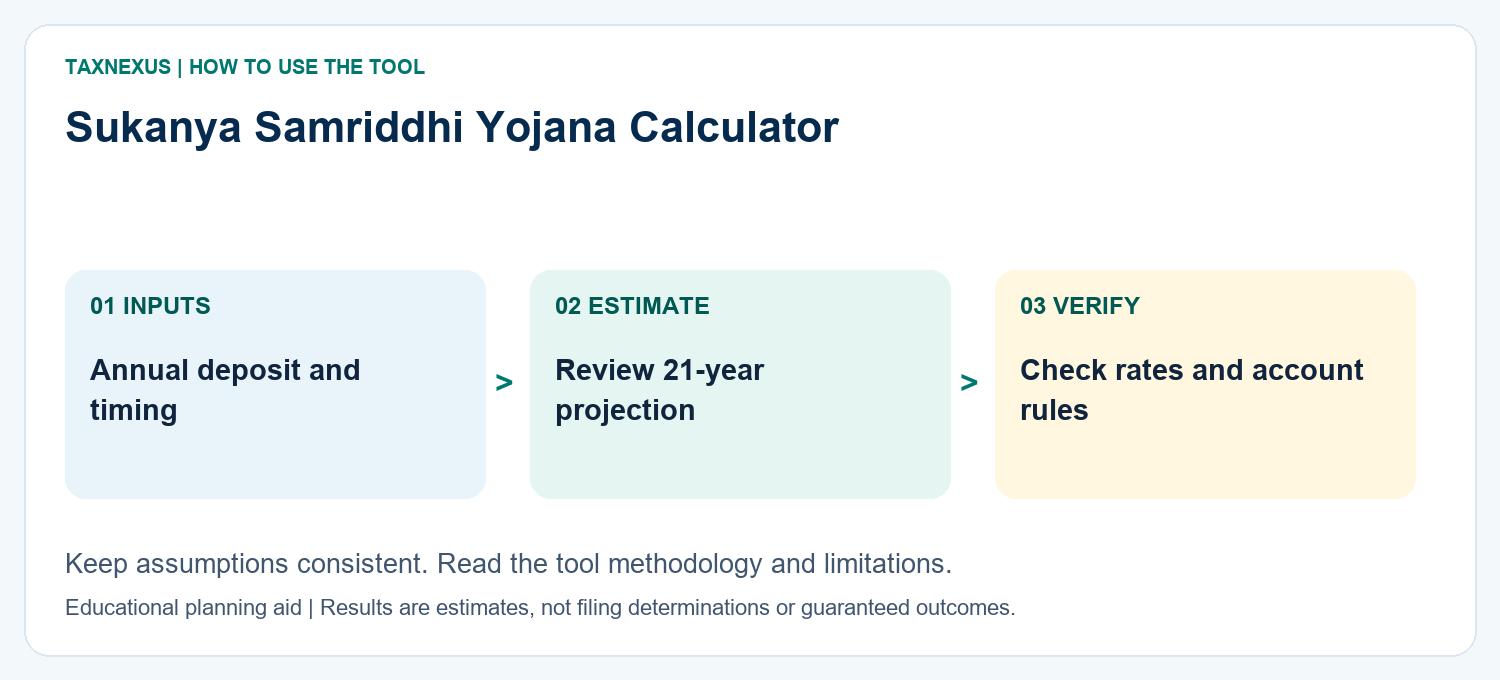
How to read your SSY result
The calculator estimates Sukanya Samriddhi maturity using your deposit schedule and assumed notified rate. Government small-savings rates can change during the account term.
Planning note: Verify the latest SSY rate and scheme rules before relying on the projection.
Need help comparing scenarios or want a custom finance worksheet? Contact TaxNexus and tell us what you are trying to calculate.
Ask TaxNexus
Send your question and the TaxNexus team can review what you are trying to calculate. The calculator page is included automatically.
Safety: Do not send passwords, OTPs, card numbers, bank login details or other confidential credentials.